


Innova Exhibition Cotton Gloss IFA45 Review
Review – Innova Exhibition Cotton Gloss 335gsm
Innova Exhibition Cotton Gloss IFA45 paper review

No more Google ads. Too many deceptive and irritating adverts.
Any ad links left are non tracking, to companies we know, trust and we've worked with for years [Park Cameras]
Ads helped pay for site running costs, so if you found something useful, please
...Make small KoFi donation?
...Subscribe to Keith's YouTube Channel
...Get Keith's book about how to use tilt/shift lenses
Our site contains affiliate links - these help support the site. See our Advertising policies for more
Keith has used Innova’s IFA45 paper for many years – This was originally reviewed in 2011 as Innova Warm Cotton Gloss
The paper is Innova IFA-45 part of their ‘Editions Range’
The paper is tested on the Epson P5000 17″ pigment ink printer [P5000 review]
Our samples were kindly supplied by Innova the UK.
Innova papers are available from many outlets internationally.
About Innova Exhibition Cotton Gloss…
The paper is one I’ve used in a range of printers over the years, and have used for some large B&W exhibition prints where I wanted a natural white finish, and the light surface texture of the paper.
Key features (from Innova)
IFA 45 – Innova Exhibition Cotton Gloss
- Smooth Gloss
- 100% Cotton
- Natural White
- OBA Free
- Acid – Lignin Free – Archival
- Crystal Layer Coating Technology
- Pigment and Dye Inkjet Compatible
Description
Featuring crystal layer technology, developed for Innova Art’s range of FibaPrint digital darkroom papers, this archival inkjet cotton rag photo paper features a stunning gloss finish. Innova Exhibition Cotton Gloss 335gsm has been designed to meet the aesthetics of traditional techniques used in chemical darkrooms. Contemporary photographers can create archival inkjet prints from their digital files with the feel of prints produced using traditional techniques.
The 100% cotton rag base of this archival inkjet photo paper lends a natural white tone to printed artwork as well as imparting a luxurious feeling of substance to the finished print. The smooth gloss surface features similar qualities to traditional platinum/palladium darkroom papers: a light diffusing soft gloss, capable of reproducing a large tonal range with subtle graduations and deep, rich blacks.
Acid and lignin free, as well as free from OBA (Optical Brightening Agents) Innova Editions Exhibition Cotton Gloss 335gsm meets the highest archival standards.
Specifications
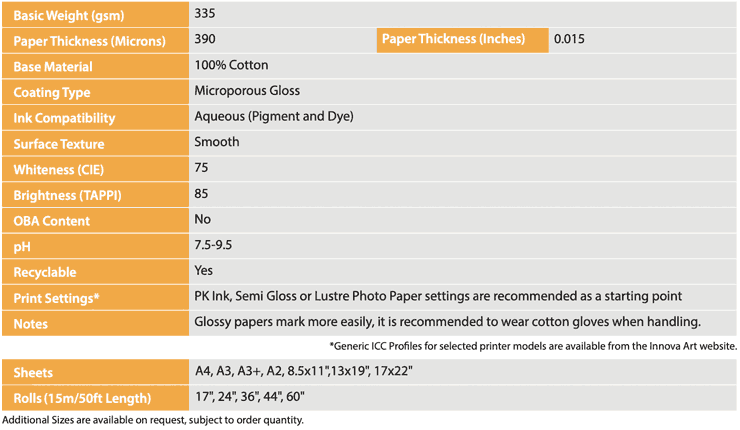
Full details of the paper are on the Innova IFA45 product page.
My video overview of why I often use IFA-45
ICC profiles and media settings
The paper (17″ roll) was tested using the Epson P5000 pigment ink printer. For profiling the initial media setting was Baryta and photo black ink was used.
The papers were profiled using X-Rite’s i1Profiler and ~2900 patch targets. My P5000 profile is available on request – for non commercial use.
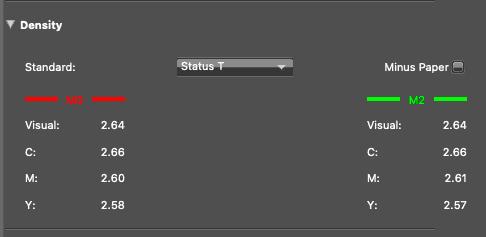
The black readings show a good deep black.
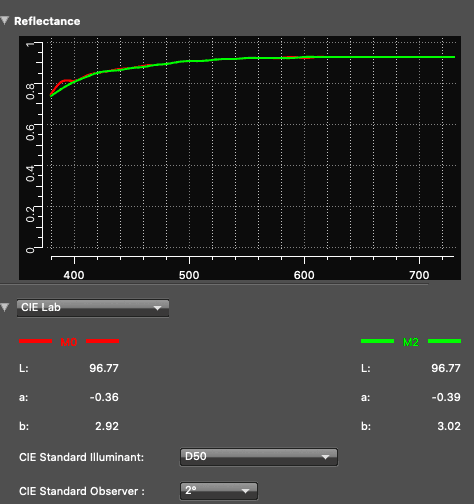
The spectral curve of the paper shows the general slight warmth of the paper and virtually no change between the curves with UV added [red] or cut [green]
The paper was also tested using the Epson ABW print mode for black and white.
When I used this paper with the Canon iPF8300 in the past I had to create a slight adjustment curve to linearise the B&W print output.
Here’s the linearity check graph for IFA-45 on the Epson P5000

The important bit is the line of ‘L’s – essentially straight.
This means that for B&W printing on the P5000 (and hence P7000/9000) I need make no adjustments whatsoever if printing with the Epson ABW mode. The absolute level of black on my old iPF-8300 was fractionally deeper [2.7] BUT I needed to adjust the print output for linearity and make a small tweak to the ‘tint’ in the Canon B&W print settings to allow for a tiny bit of illuminant metamerism.
Take this as a good example of why people who just go on about DMax values are frequently missing the bigger picture…
If you’re curious about using this technique to correct for non linearity in B&W printing, I’ve several articles covering the process, such as one describing how I set about using a new paper for printing.
As an aside, I’d note that this paper, printed with the ABW mode for the P5000 needed a -5 tint adjustment [to the green] in the driver to get a neutral tone, For the P5300, the tone was better unadjusted. This will vary by paper and printer.
Print Quality – Innova Exhibition Cotton Gloss
I used this paper when making a B&W print from a 100MP GFX100S image
[There is a video [24mins] about the workflow and printing for this image]
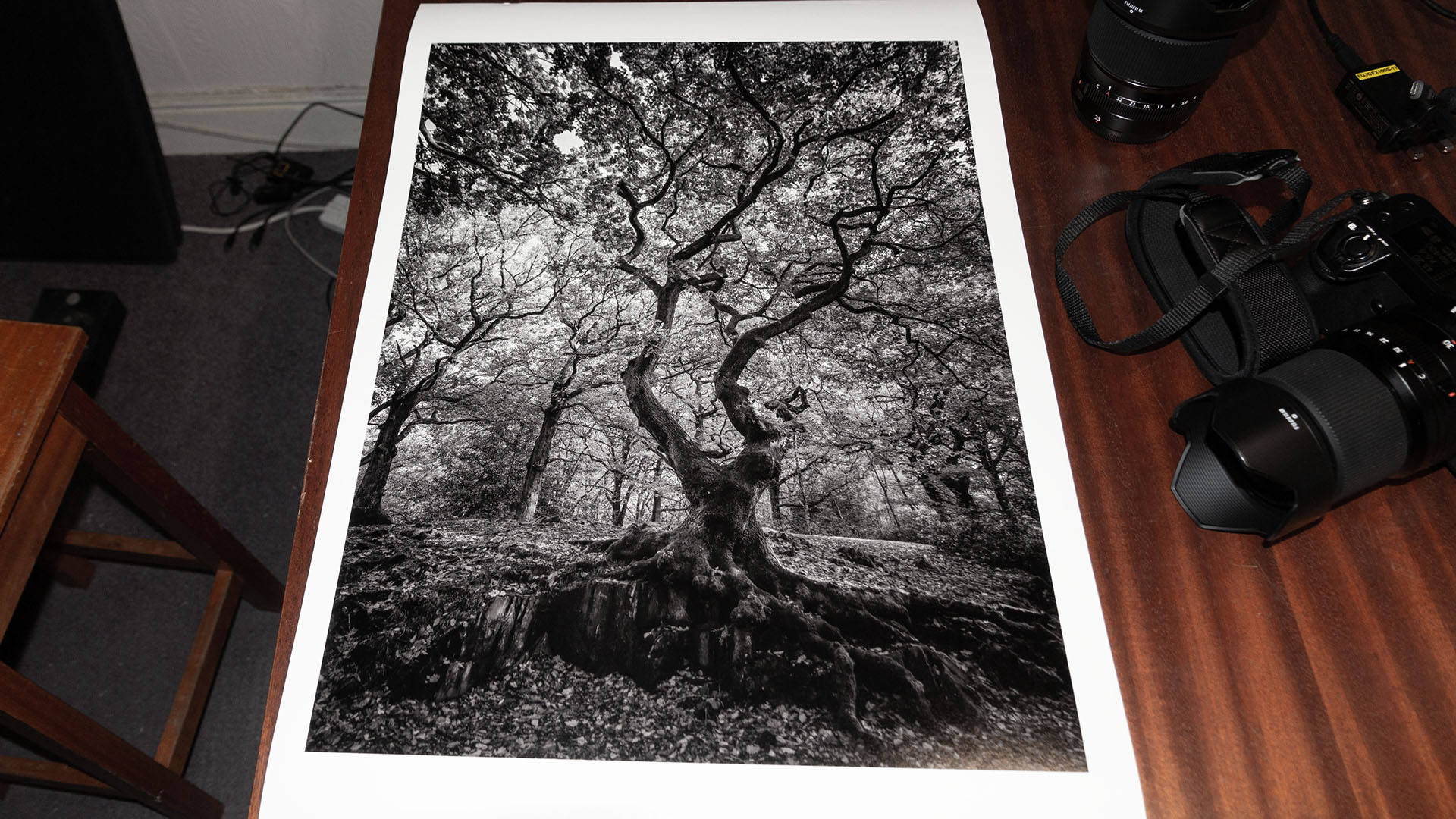
Innova Exhibition Cotton Gloss has been one of my favourite papers for large B&W prints for many years.
I usually print my images directly from Photoshop, although with the Epson P5000 I could just as easily use Epson Print Layout.

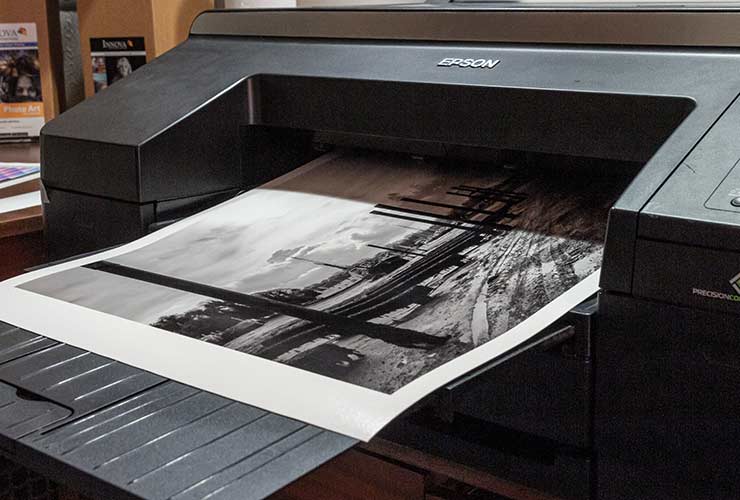
The slipway at Pin Mill in Suffolk. on a winter’s day with weak watery sunshine – I don’t want this printed on a bright white paper. It might look OK on a smooth natural white art paper as well.
Here’s that print on its way out of the printer, lit to show the surface texture and sheen.

A wider view.

What about colour images?
They look great, but for colour I have a much larger range of papers I like. For example, ones with a bit of optical brightener, give a bit larger gamut in the highlights on a bright sunny day.
Equally so, the IFA-45 warmth (slight as it is) can give a better look to sunsets and warmer coloured images.
That said, if you absolutely don’t want OBAs and want a bit more contrast than an art paper, then Innova Exhibition Cotton Gloss is a good option.
Summary – Innova Exhibition Cotton Gloss IFA 45
A solid feeling paper – the slight warmth and surface texture has long appealed to me for some of my B&W images.
The warmth is as close as I get to toning or tinting.
Innova Exhibition Cotton Gloss is essentially the same paper I reviewed in 2011 – I’ve used it for exhibitions mainly for B&W, previously with a Canon iPF8300 and here with an Epson P5000. Apart from the name, the main difference is that in this test the prints come off the roll almost flat.
Getting the best from any such paper requires the right image, and print setup. If you are going to be using a paper consistently, then take time to check its linearity for B&W and print accuracy for colour.
-- --
Never miss a new article or review - Sign up for our Newsletter (2-4 a month max.)More print related information from Keith
...or use the search box at the top of any pageReference pages and test images
- Printer Test Images
- B&W printer test image
- Printer cleaning
- Paper reviews
- Printer info/news/speculation Canon | Epson
No more Google ads. Too many deceptive and irritating adverts.
Any ad links left are non tracking, to companies we know, trust and we've worked with for years [Park Cameras]
Ads helped pay for site running costs, so if you found something useful, please
...Make small KoFi donation?
...Subscribe to Keith's YouTube Channel
...Get Keith's book about how to use tilt/shift lenses
Our site contains affiliate links - these help support the site. See our Advertising policies for more
Keith | Nov 7, 2022 at 5:46 pm
Ah yes, I’ve tried showing prints at some of my talks in less than stellar lighting ;-)
Ian Douglas | Nov 7, 2022 at 5:20 pm
Keith,
I love the Innova range and personally use some of their ‘art’ range. Unfortunately Innova used to have a slighty lower price than other premium papers but this has been eroded in the last few years. It is however very rare (for me) nowadays to ever print on gloss papers (even soft gloss) despite their fantastic DMax etc due to the reflections. It is also quite rare (and sometimes commented on occasion negatively (very rarely though I am glad to say) if gloss prints are entered in camera club competitions. This is usually due to the abysmal lighting often used for prints and print competition. I have seen everything from greenish church hall lights 30 feet in the air to a floor mounted tungsten halogen ‘garage’ light. Monochrome prints are commonly murder at inception! Although some clubs (often wealthy or graced with a skilled carpenter/electrician) have better lighting most do not. As such most camera club members use lustre, smooth matt or textured surfaces including me. In case of the lustre the surface allows clumsy and careless handling of ones’ masterpiece!
I always enjoy your detailed analyses of papers so please keep this up.