


Review: Laowa 35mm f/2.8 Tilt-shift 0.5X Macro Lens
Review: Laowa 35mm tilt shift
TS f/2.8 Tilt-shift 0.5X Macro Lens
35/2.8 Laowa tilt shift lens
35mm Full Frame and Medium Format
Available in a wide range of mounts Sony FE / Nikon Z / Canon RF / L Mount / Fuji G / XCD

No more Google ads. Too many deceptive and irritating adverts.
Any ad links left are non tracking, to companies we know, trust and we've worked with for years [Park Cameras]
Ads helped pay for site running costs, so if you found something useful, please
...Make small KoFi donation?
...Subscribe to Keith's YouTube Channel
...Get Keith's book about how to use tilt/shift lenses
Our site contains affiliate links - these help support the site. See our Advertising policies for more
Keith has been testing the new 35mm focal length tilt/shift lens from Venus Lens [Laowa].
The Laowa 35mm TS, a f/2.8 Zero-D Tilt Shift 0.5x Macro gives 10º of tilt and ±12mm of shift [±8mm on medium format].
This review looks at aspects of its use and performance on the 100MP Medium format [33x44mm sensor] Fujifilm GFX100S.
The Laowa 35mm tilt shift is available from Venus Lens: Product Info Pages

The Laowa 35mm Tilt Shift
It’s been a long time since Nikon and Canon produced a 35mm tilt/shift lens for their ‘Full frame’/35mm systems, and most other camera makers leave anything with lens movements [tilt and shift] well alone.
The 35mm ‘focal length gap’ has been a feature of Canon TS-E and Nikon PC-E lenses, so much so that using a 24mm lens and a 1.4x teleconverter has been the only real option if you needed that coverage. If you’re curious, I have a brief comparison of TS-E24+1.4x TC later. I’m testing the G mount version of the lens on the 33x44mm sensor of the GFX100S
There is a Fujifilm 30mm tilt-shift lens in G mount [see my detailed 30 TS review] but it costs at least four times what the new Laowa 35mm tilt shift does.
I’ve several videos looking at aspects of lens use at the foot of the article, including reviews and tests of the physically similar Laowa 55mm and 100mm tilt/shift lenses.
Main review video [37 mins]
The 35mm lens gives the roughly equivalent field of view [FOV] of a ~28mm lens on ‘full frame’, on my GFX – so if wondering what one of my sample images might look like on a full frame camera – just crop…
The ’28mm’ FOV gives a wide but not unnaturally so view for buildings. Shown here with some 6-7mm of upwards shift [aka ‘rise’]. Click to enlarge

Wygeston’s house, Leicester. This modern extension is from 1796, the main building dates from 1490.
The all metal lens is quite hefty [over 1.3kg] and has a very solid feel to it. With a f/2.8 aperture it’s decidedly easier to show the effect of strong lens tilt than the f/5.6 Fuji 30mm TS.
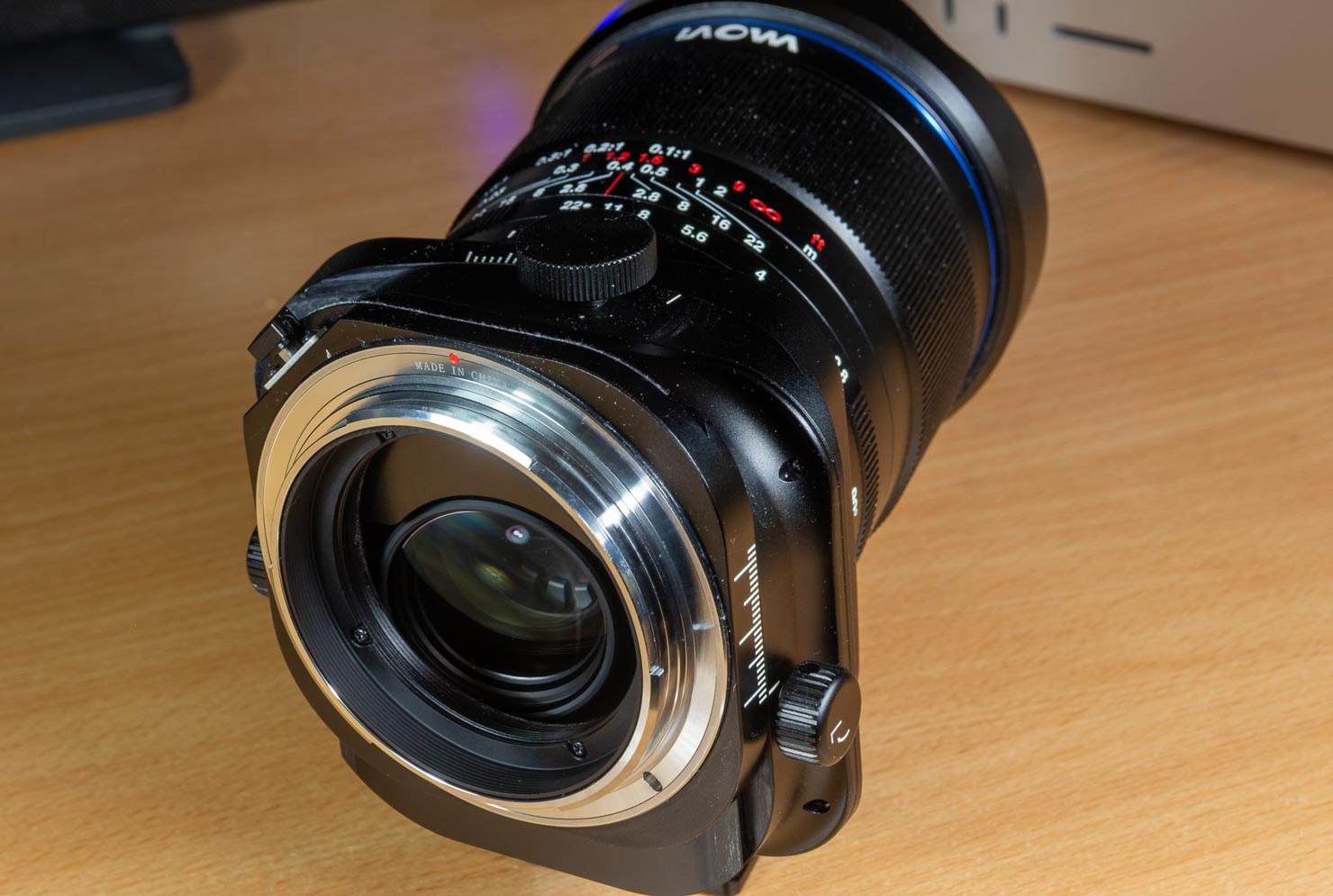
Here’s the Laowa 35mm tilt shift [G mount] showing it with detachable lens hood and the lens foot [Arca style mount].
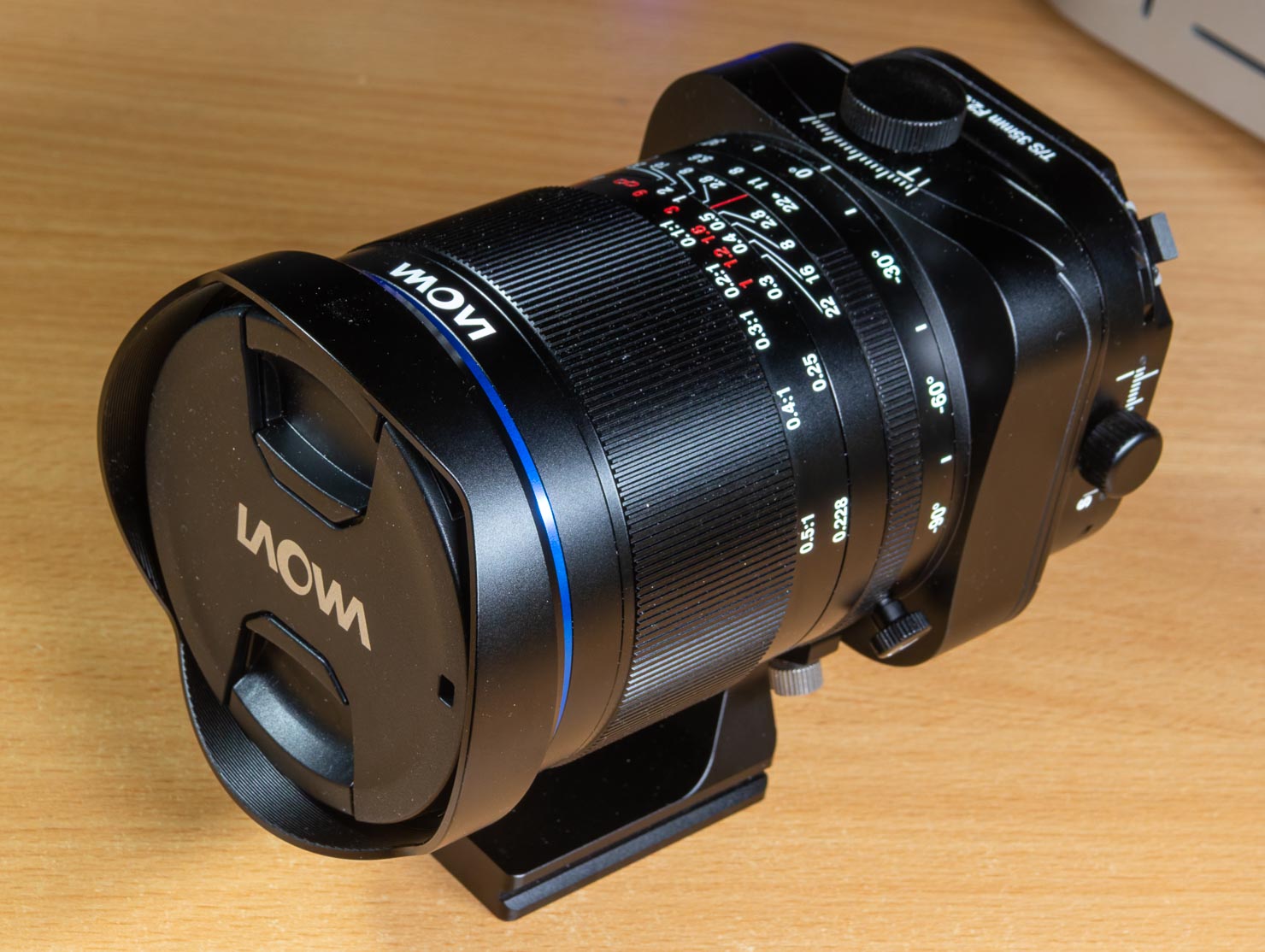
The lens takes 77mm filters.
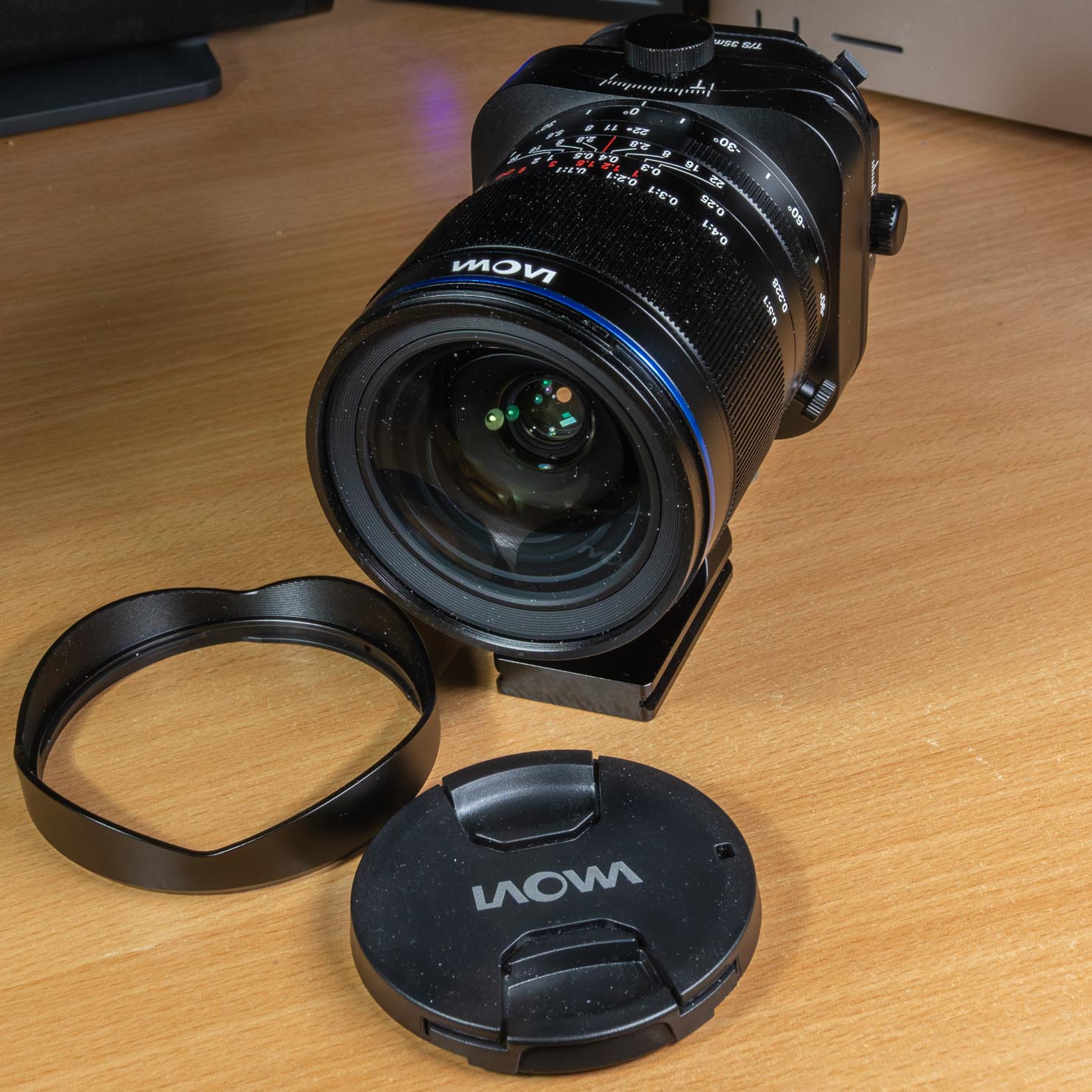
The lens foot means the lens can be kept fixed whilst shifting the camera – ideal for stitching images.
One minor niggle – the lens cap spring releases are smooth on the inner surfaces – this sometimes makes Laowa lens caps a bit tricky to fit/remove. These can just flip off when fitting, and bounce off the front element.
No problem here, since I could use the outer grips, but have a lens hood fitted and I find I need to use the inner ones.

Here’s the camera mounted on my Rogeti RG1 geared head and tripod – my first choice for my architectural photography.
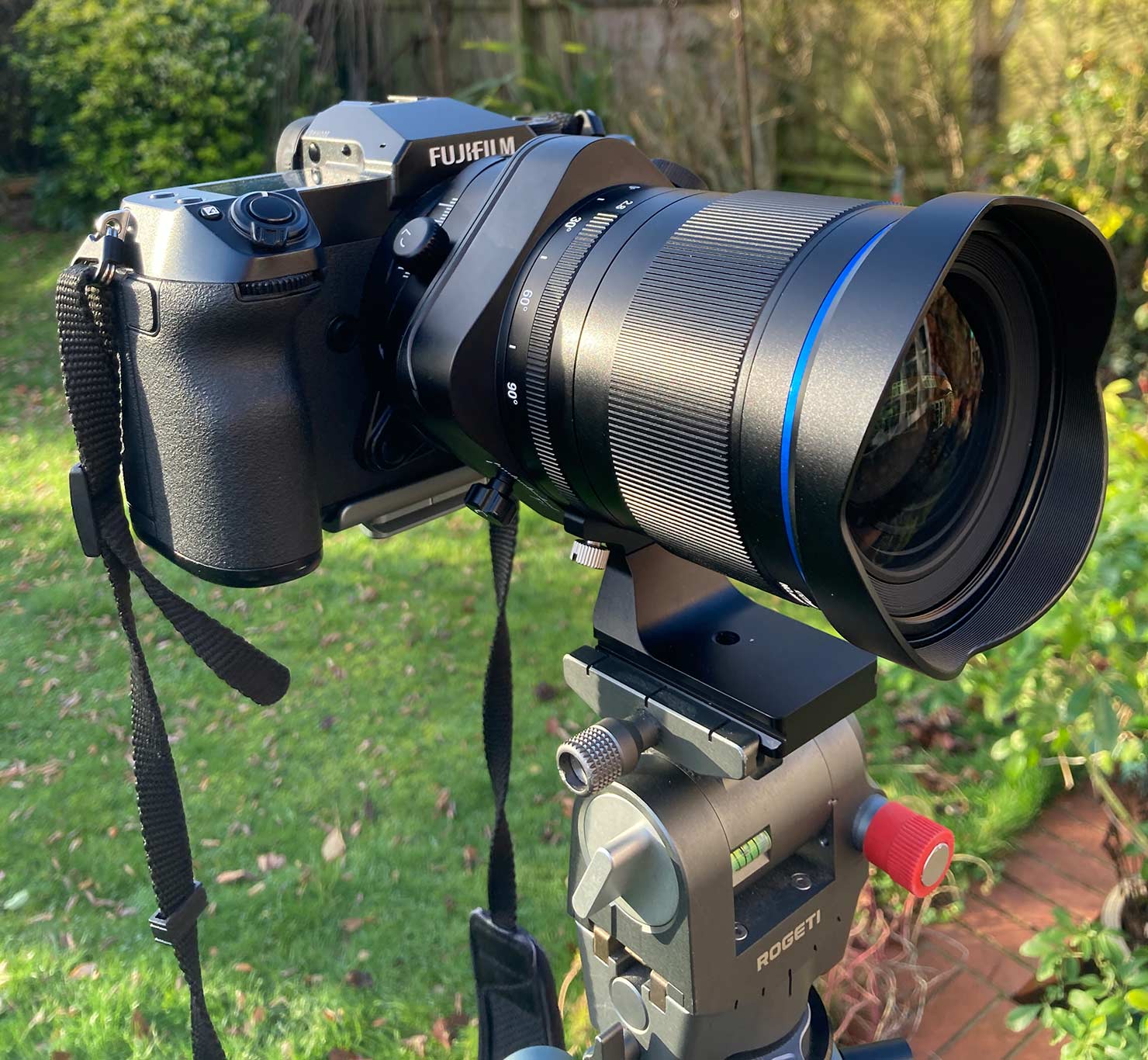
Note how the shift axis is at an angle. The lens can be rotated in the lens foot ring, as well as the rotation at the lens mount.

The rotation lock [with an ‘L’] and the foot attachment screws. The foot can be reversed for better balance, with a heavier camera. Also clearly visible, the tilt and shift setting knobs and indicators.
The locking knob for shift. The one for tilt is underneath, opposite the tilt control knob on the top.

You can see how the tilt and shift controls are set at 90º to each other, this relationship is fixed [unlike the 55 and 100mm versions of the lens].
The shift movement has a detent at zero shift, but the tilt axis doesn’t, so take care to check every so often that you have not introduced an unwanted tilt.
Take care not to over tighten the locks – this has long been a potential source of damage for many tilt/shift lenses.
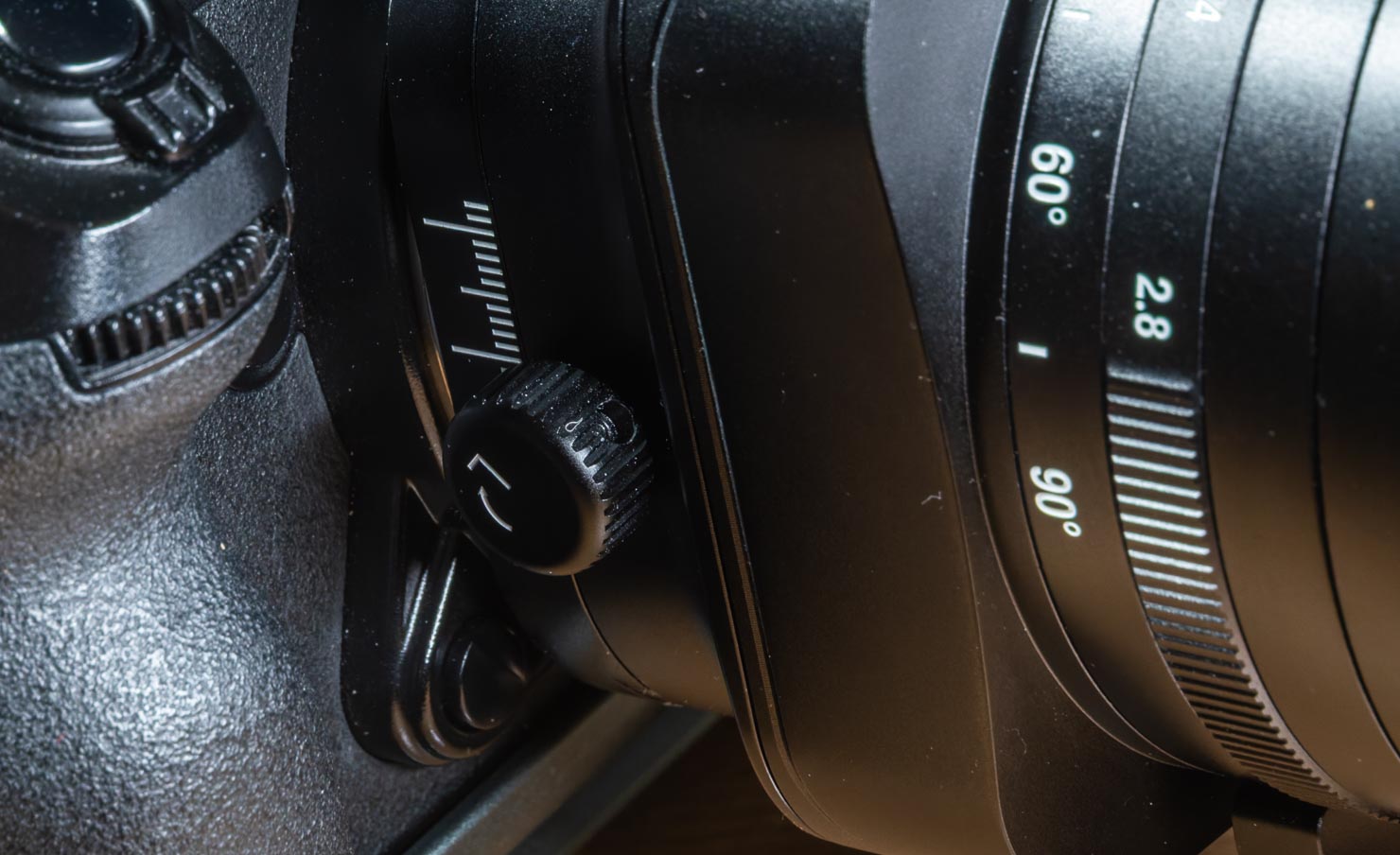
The lens can also be rotated on the mount, with detents at useful 15º steps.
A small button [next to the camera maker’s name] allows this movement.
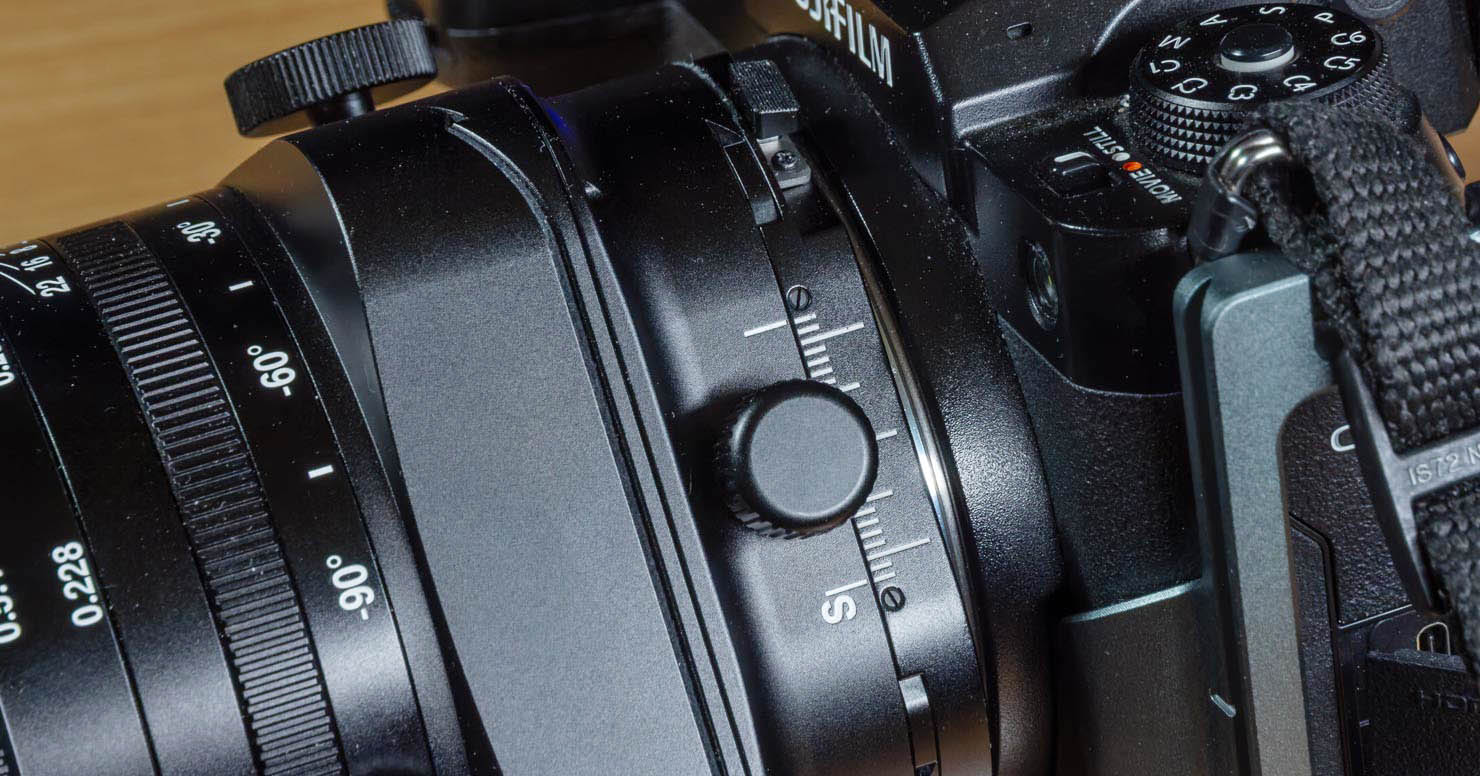
Since the lens is 100% manual in operation, it can be rotated fully 360º.
There are no electronics in the lens, so no lens EXIF data will be recorded. For the GFX100S I set the ‘lens adapter’ setting to 35mm.
Laowa 35mm Tilt Shift Lens settings/controls
Aperture and focus rings are smooth, with soft full stop clicks on the aperture.

I’d prefer the aperture ring to have slightly more raised grooves, since I found it a little fiddly to move on occasions.
Close focus [~100º throw] or macro at 0.5:1 looks good until you note that the plane of focus is only some 6-7cm from the front element. The lens hood easily comes off, but the front of the lens could affect subject lighting. I’ve some examples [and video] later, showing how the amount of tilt of the focal plane drops off as you get closer, using the 55mm and 100mm TS lenses.
Laowa 35mm Tilt Shift Specifications
| Name | Laowa 35mm f/2.8 Zero-D Tilt-Shift 0.5x Macro |
| Format | Full Frame [24×36] / Medium Format [33×44] |
| Focal Length | 35mm |
| Aperture Range | F2.8-22 |
| Angle of View | 87.5° |
| Tilt | ±10° |
| Shift | ±12mm |
| Mount Rotation | 360° |
| Magnification | 0.5x |
| In-focus driving mode | Manual Focus |
| Lens Structure | 14 elements in 12 groups |
| Aperture Blades | 15 |
| Min. Focusing Distance | 22.8cm |
| Filter Thread Size | Ø77mm |
| Dimension | Approx. Ø148.9mm* Ø104.9mm |
| Weight | 1,350g (exclude front cap & rear cap ) |
| Mounts | E/Z/RF/L*/GFX/XCD |
| Price | USD 1,249 |
| *Note: Not compatible with the following Panasonic Lumix models: S52 S1M2 S1R2 S1M2E S5M2X | |
There are a few limitations in using the lens, which depend on the mount and sensor size.
Maximum shift for medium format sensors is best limited to no more than ±8mm [see the vignetting examples below]. That doesn’t mean you can’t use the full ±12mm, just that you have to expect some impact on image quality.
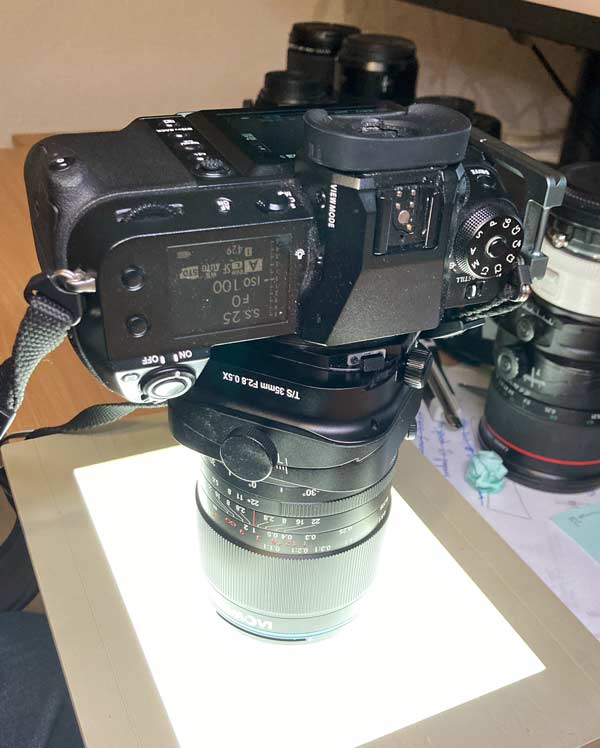
A more subtle limitation comes from the position of the rear element which, with the lens at infinity, is close to the lens mount. This means that you cannot use full shift and tilt at the same time. This depends on which lens mount option you are using.
Two examples at full 10º of tilt
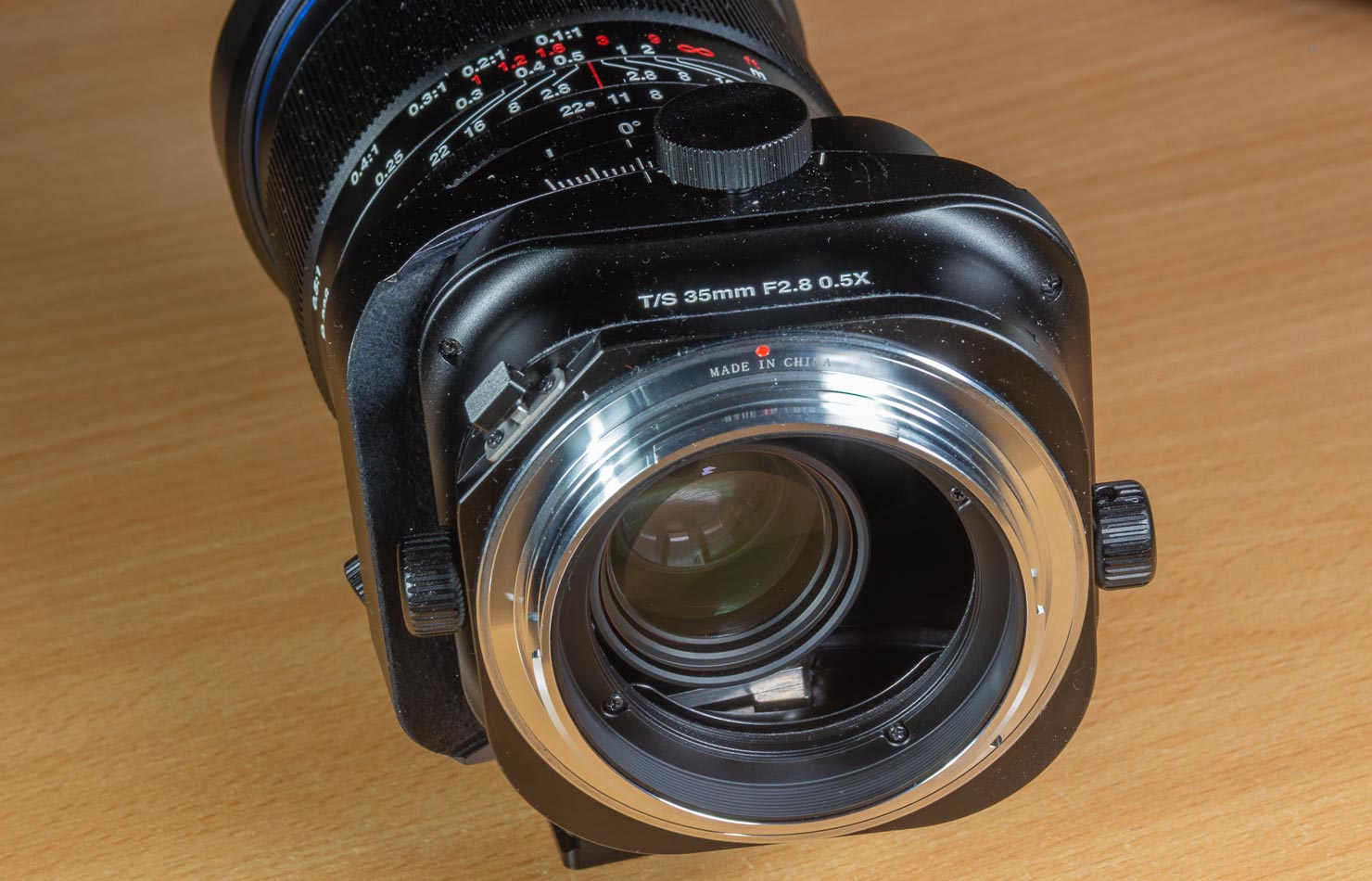
Lens set at ~0.5m
The lens rear element moves with focus.
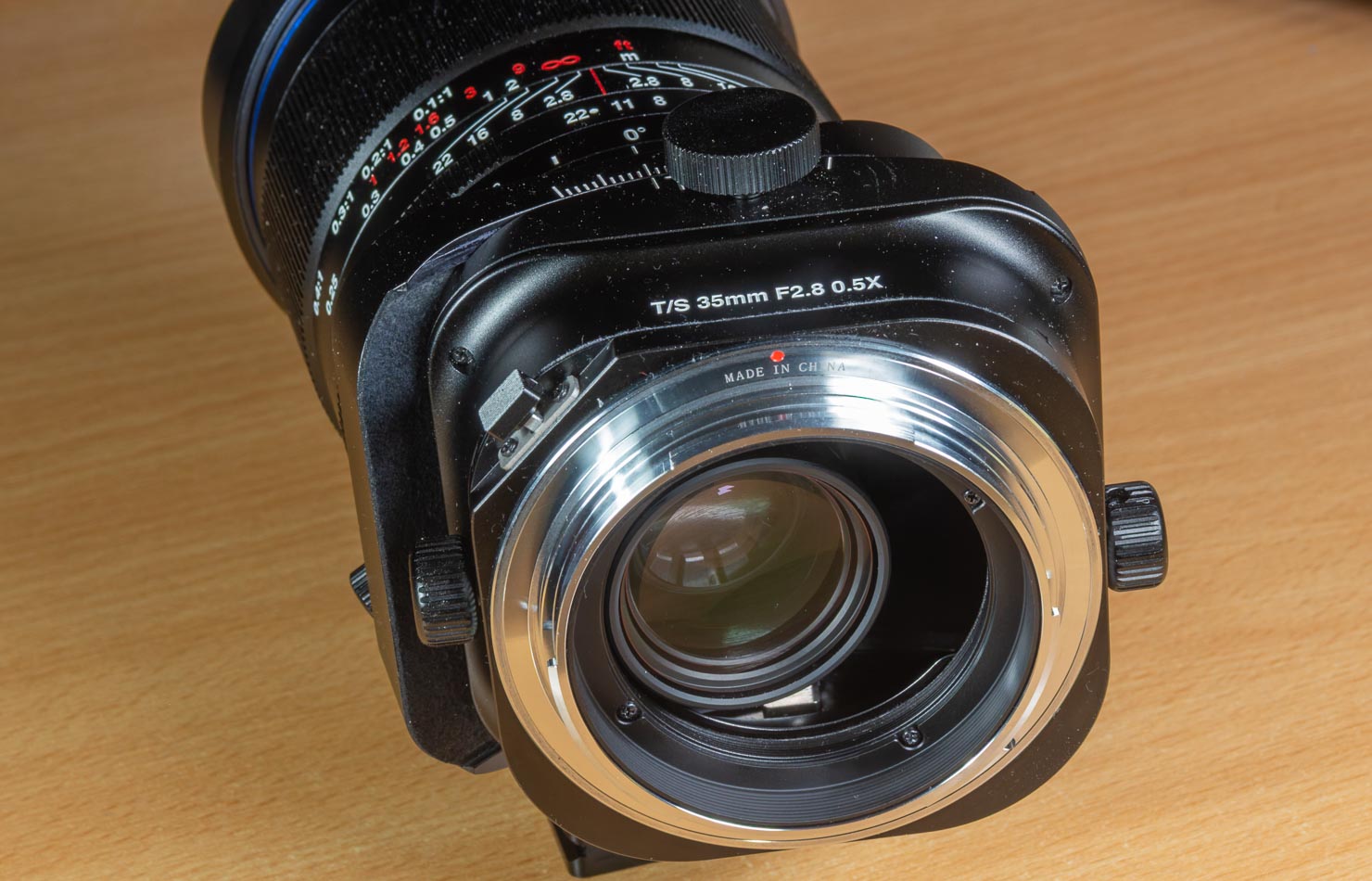
Lens set at infinity
Here’s just shift.
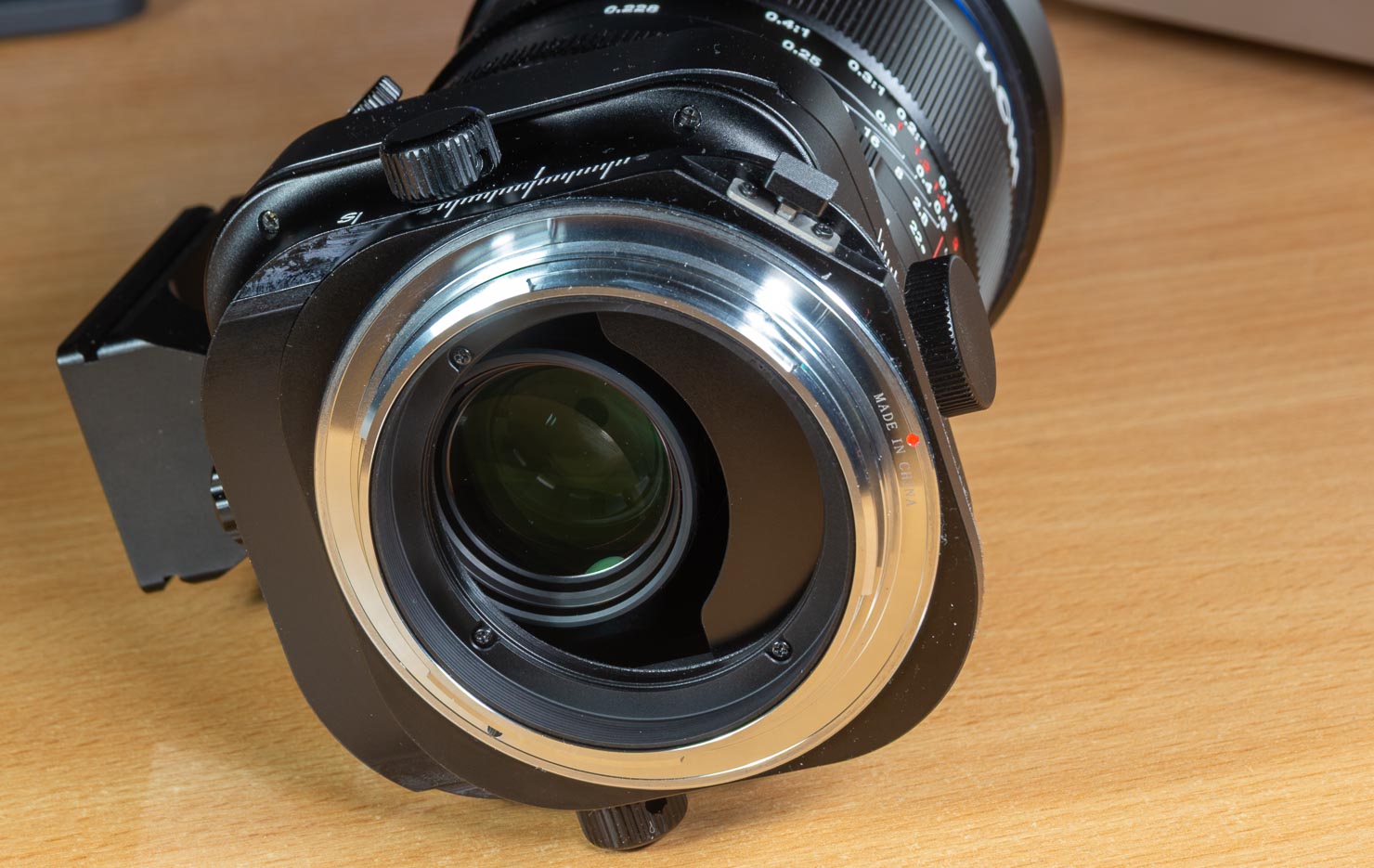
Lens at full shift
At full shift, available tilt is reduced to just 4º
Tilt limit at full shift
Limitations on image quality mean that I’m unlikely to want full shift and tilt at the same time when focused at infinity [landscape for example]. Fortunately if you want tilt and shift at closer distances, the rear element is further to the front, so movement limitations are reduced, but they may still intrude.
The relatively large rear element group is shown in the construction diagram below.
Laowa 35mm Tilt Shift MTF chart

Laowa 35mm TS Optical design

Although not tested myself, I’ve heard from someone using the lens on an Infra-red adapted mirrorless camera, where it worked very well, with no extraneous ‘hot spots’.
Laowa 35mm Tilt Shift lens quality [and sensor type]
I’ve just the one example of the lens to test, so no detailed performance measurement data I’m afraid.
Since I’m testing the G mount version of the lens, the sensor is capturing more of the image circle of the lens, which is stated to be 67mm diameter.
An example showing the comparative scales of the image circle, and fields of view of unshifted sensors [FF and MF]. Note that this diagram does not reflect the actual field of view for this lens.

In the real world, lenses show fall off [vignetting] towards the edge of the image circle.
One way I test this is with a lightbox taking photos at different apertures and shift amounts.
This shows the light fall-off and any issues such as the sensor hitting/crossing the edge of the image circle.
The overall results are shown in this collection of images [click to enlarge]
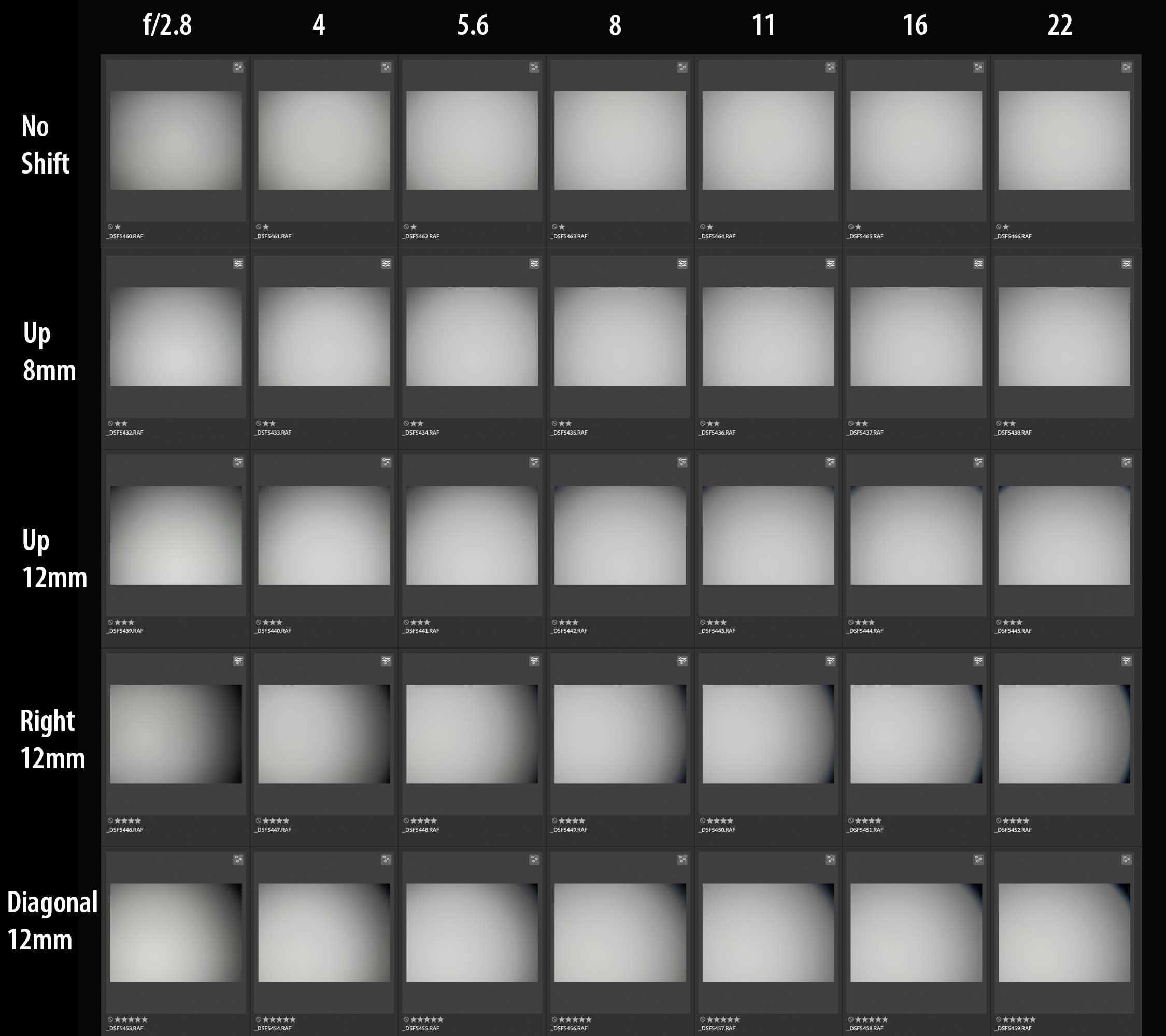
Key things to note are the normal aperture related vignetting at the top, and the strong shift of the bottom two rows showing the solid edge of the image circle. Note how it’s a sharper edge at f/22.
As in the earlier example, just reduce the size of the frame to see how a 24x36mm sensor would stay within the lens 67mm image circle at the full 12mm of shift.
This shows why the G mount version of the lens has a suggested maximum ±8mm of shift.
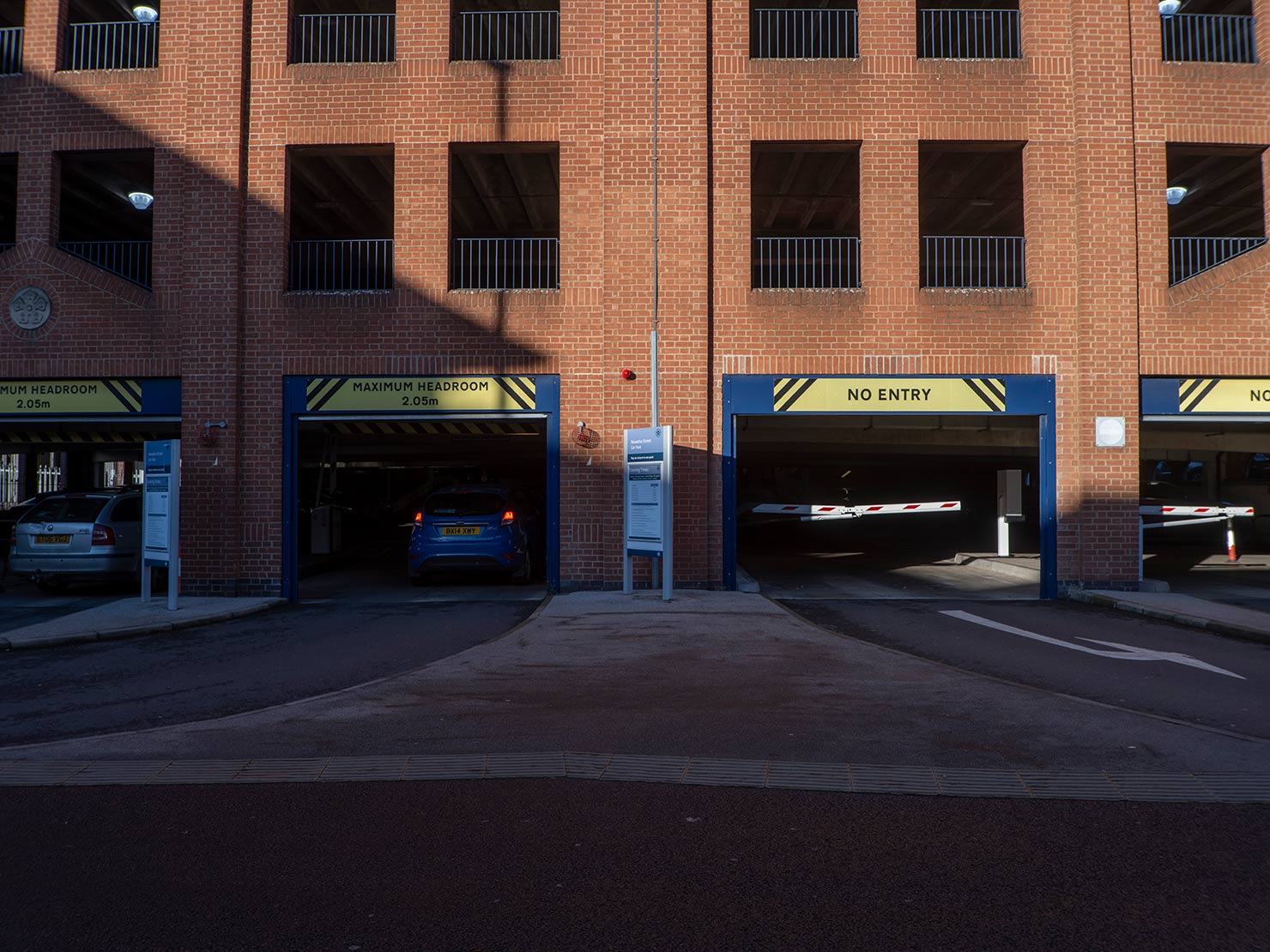
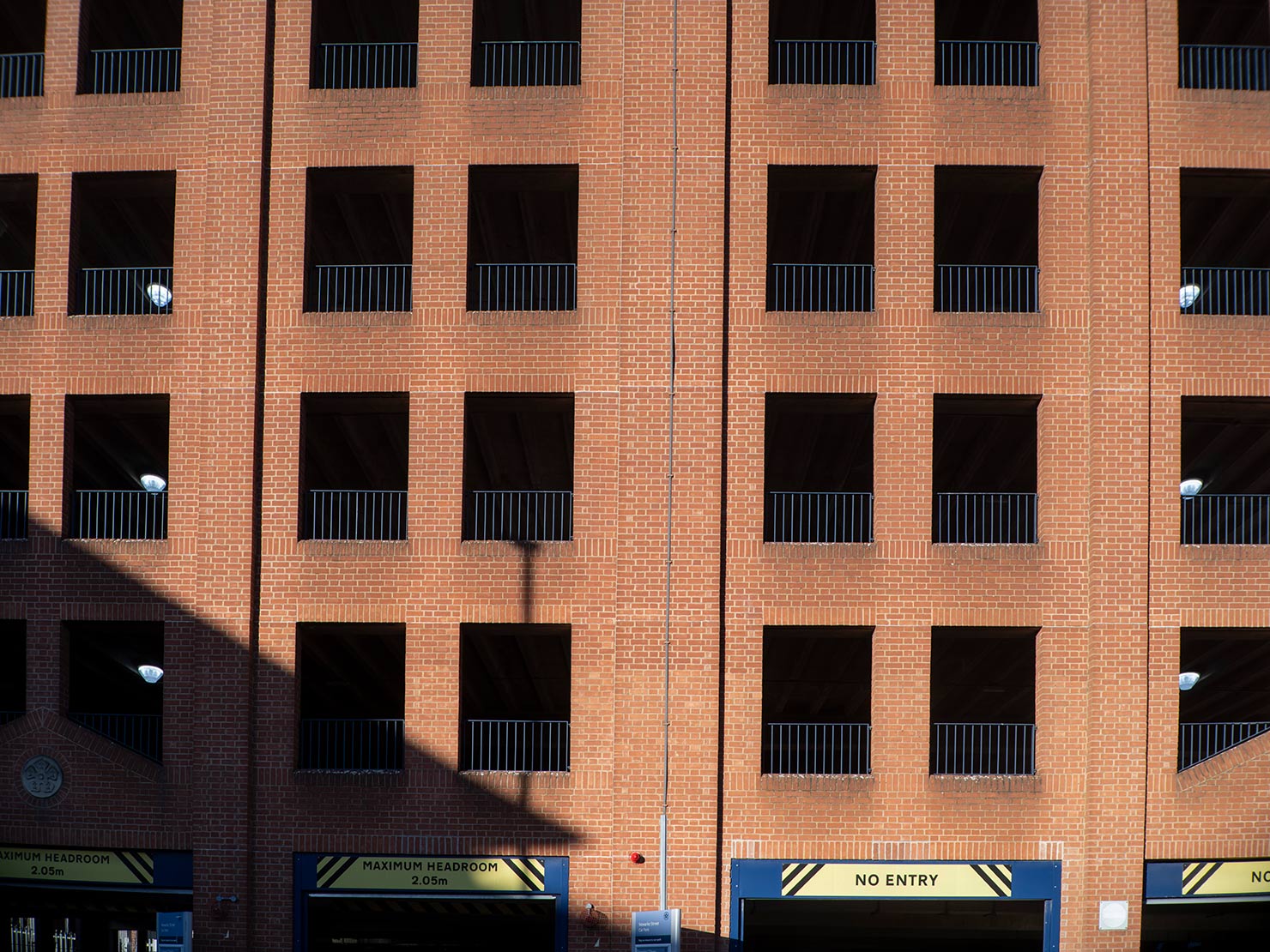
A series of shots of a car park wall give a feel for lens detail and fall off, and it’s pretty good well off the main optical axis [centre of the image circle]
Click to enlarge
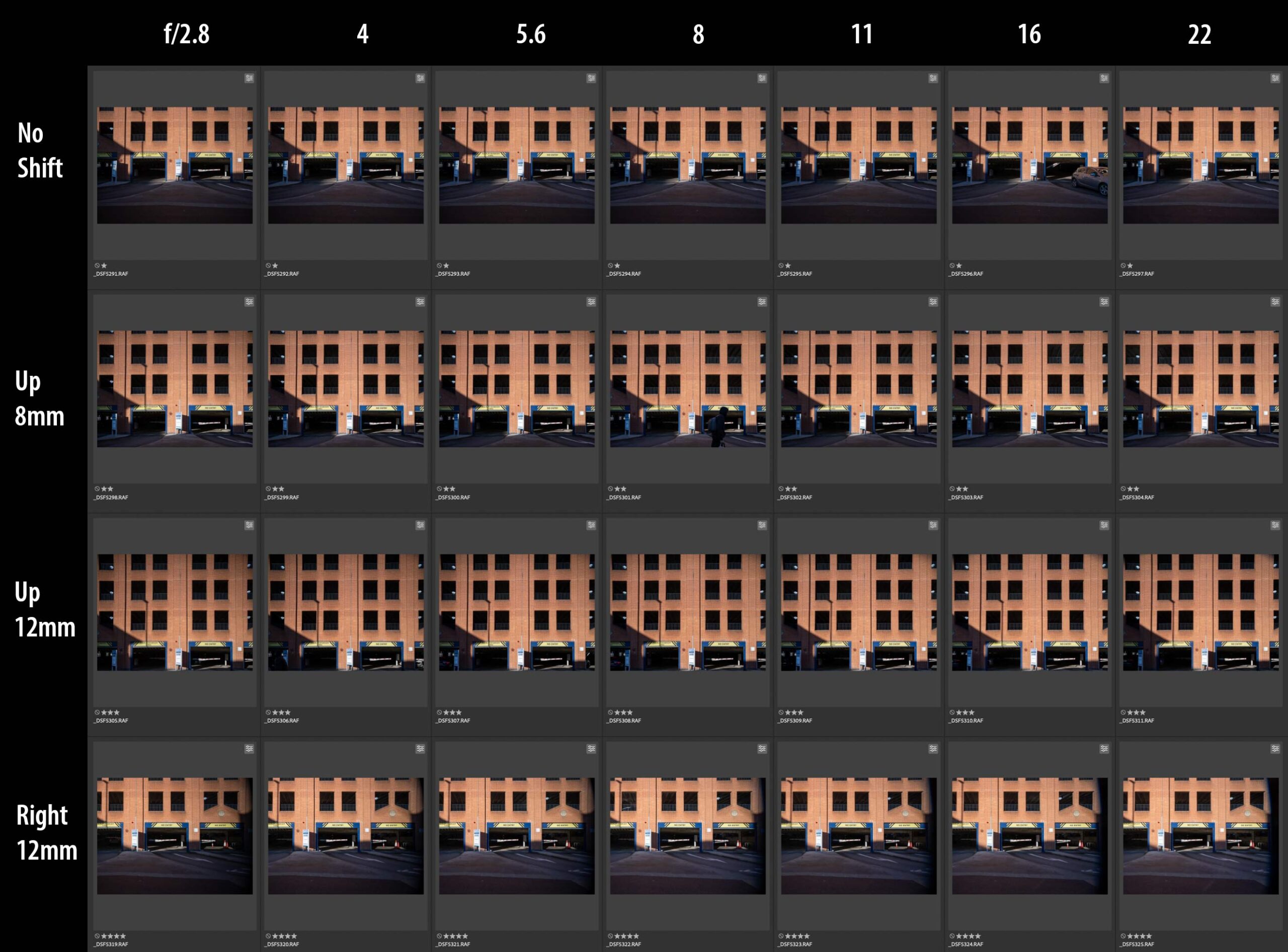
These are 100% samples, with no CA correction or additional sharpening. As these are web images, please don’t try and read too much into them – they are here for indicative purposes only!
There are some 100% samples in the DPReview thread linked from the review conclusions.
Centre of the unshifted shot at f/8
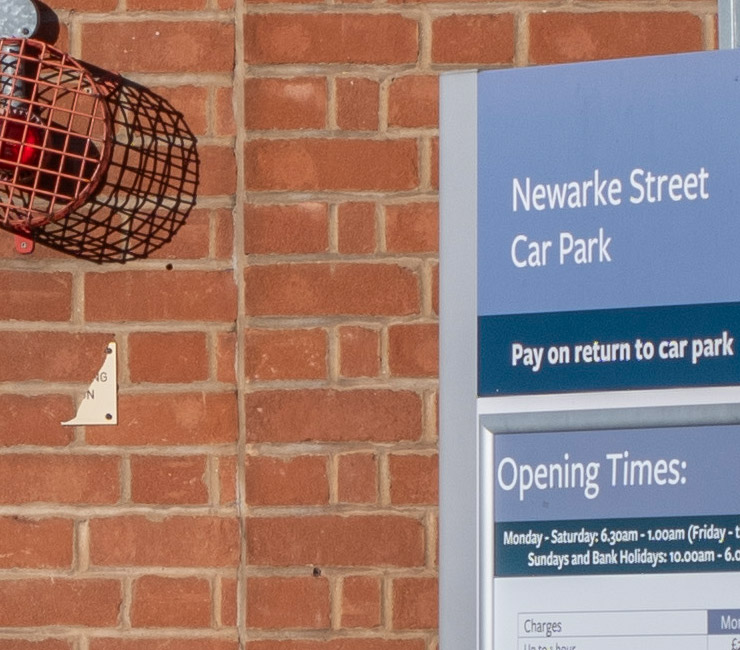
In the centre, the f/5.6 shot is a tad crisper.
Top RH corner – f/8 unshifted. This is sharper than the f/5.6 shot. f/11 doesn’t gain a lot, since you can start to see a slight softening from diffraction.

Top LH corner with ~8mm of vertical shift, shot at f/8.
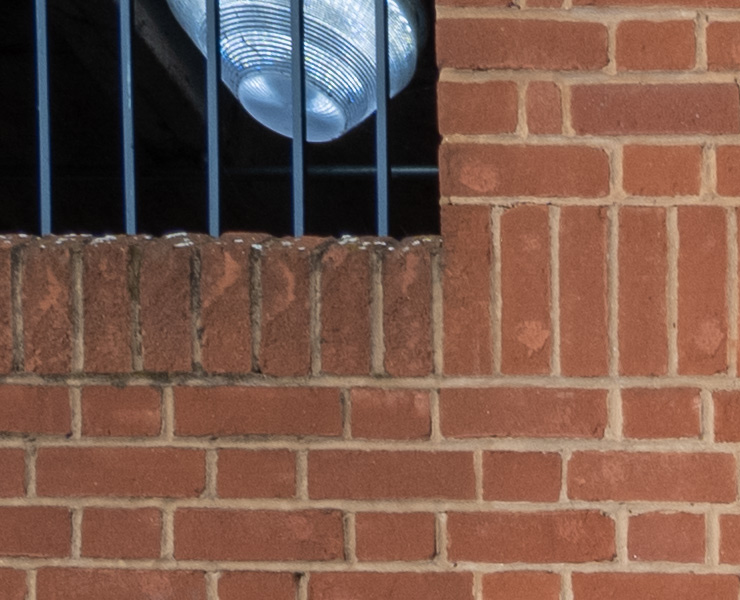
Note for anyone thinking it looks a little soft – step back and look again at the size of the whole image – this is a 100% crop from a 100MP image.
The image responds very well to sharpening, since the softness is not showing much asymmetry [as often seen when the tangental/sagital MTF lines diverge noticeably]
Lastly, top centre of the frame at f/8 and ~12mm of vertical shift.
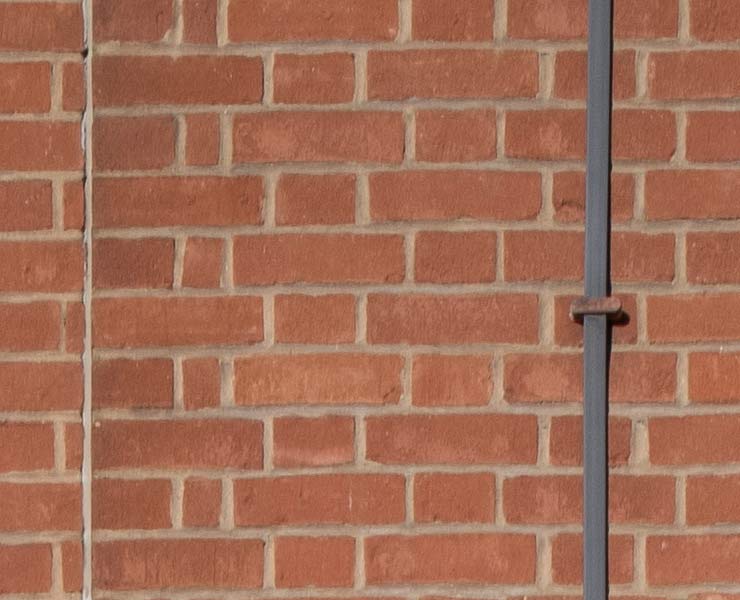
My real question, is not what the lens ‘numbers’ are, but does it have the performance for me to reliably use it on the GFX100S.
Yes… In general with less than ±2mm of shift I’d shoot at f/5.6 or f/8 depending on whether 5.6 offered the DOF I needed. If corner detail was important, it would be f/8-11 depending on the amount of shift. f/16 is fine if you need the DOF and tilt isn’t a relevant solution [I find it rarely is] f/22 is showing a general softening, as I’d expect from a 100MP 33x44mm sensor.
Obviously, that’s just for my work where a lens of this focal length would be useful.
At closer focus distances, the lens performs well, and is advertised as a Macro lens, even if some might suggest that ‘macro starts at 1x magnification.
Sensor IS on this lens?
My GFX100S has sensor based image stabilisation. This works with manual lenses if you set the lens focal length.
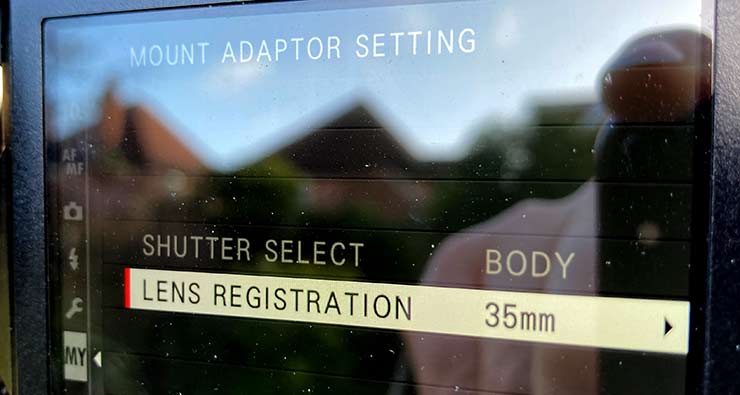
This means that 35mm will appear in EXIF data for shots as the focal length, but nothing else.
Just one note of caution if using tilt/shift lenses with IS. The camera has no concept of shift [or tilt] when trying to keep the sensor still during a shot. That reduces effectiveness of the system, but in looking at the many hand-held examples I shot for this review, it still helped.
Using shift with the Laowa 35mm tilt shift
For a lens like this, my most used feature will be shift – typically using it to keep verticals true and sometimes to take several shots with different amounts of shift and stitching them.
In showing these examples I’m very much aware of the lens having no electronics. So, whilst image EXIF data tells me the ISO and shutter speed settings, I’ve no idea of aperture and amount or direction of shift [my Fuji 30mm TS is the only lens I have which records shift info – but that’s not into normal EXIF info, so not entirely useful unless you use software like C1 – which I don’t]
In most shots the camera was level, so you can guess my eye level [many of these were shot hand held].
There are more examples in the linked videos for this review.
Flare
Shine the sun into the front of the lens and you will get flare. Not as bad as many a lens I’ve seen.
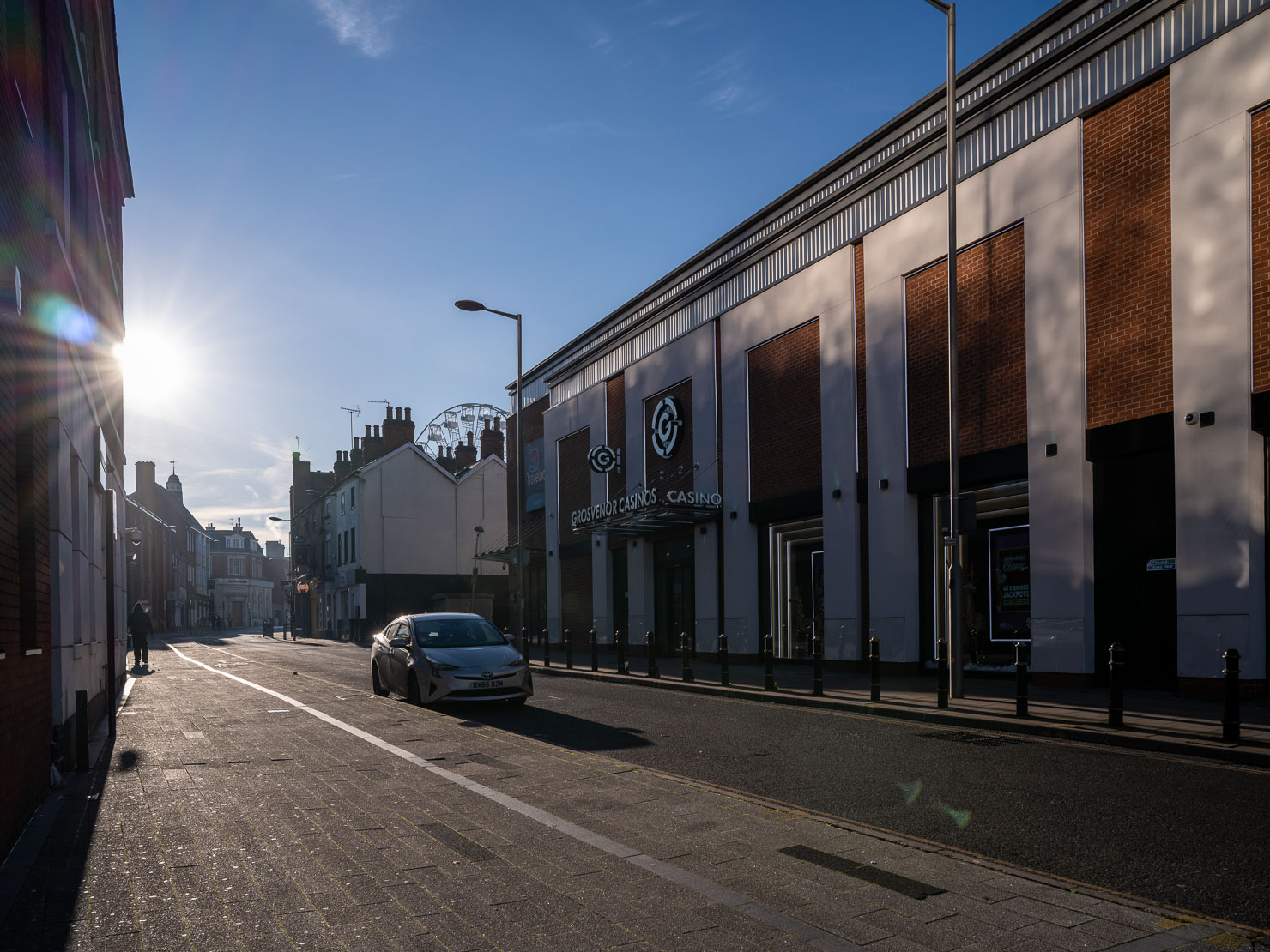
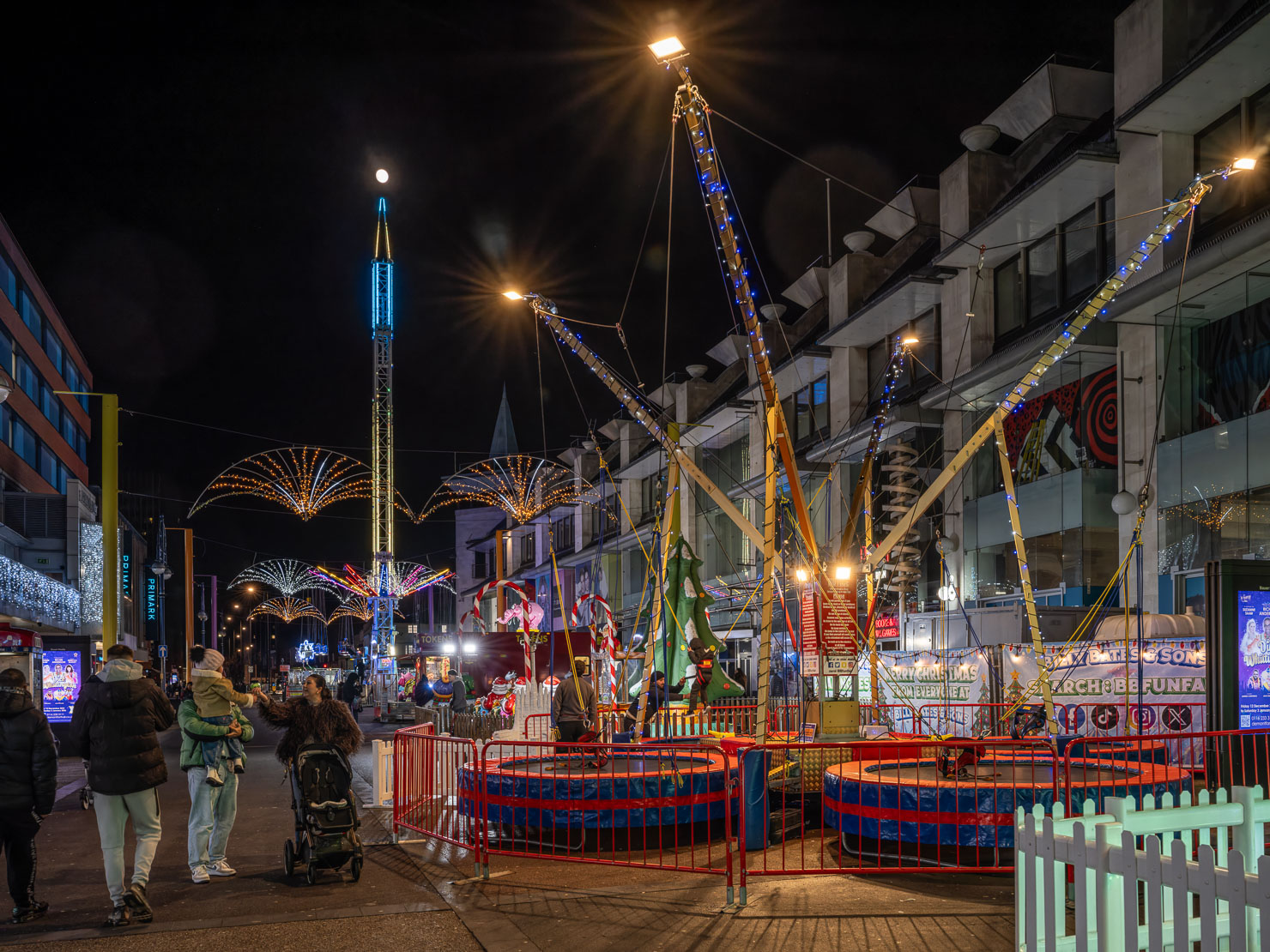
Sunstars are visible around highlights, with the 15 blade aperture giving obvious ones only on strong light sources.
The effect is nowhere near what I’ve seen with some of Laowa’s other lenses, where if you get the 5 blade aperture option, the stars are very pronounced.
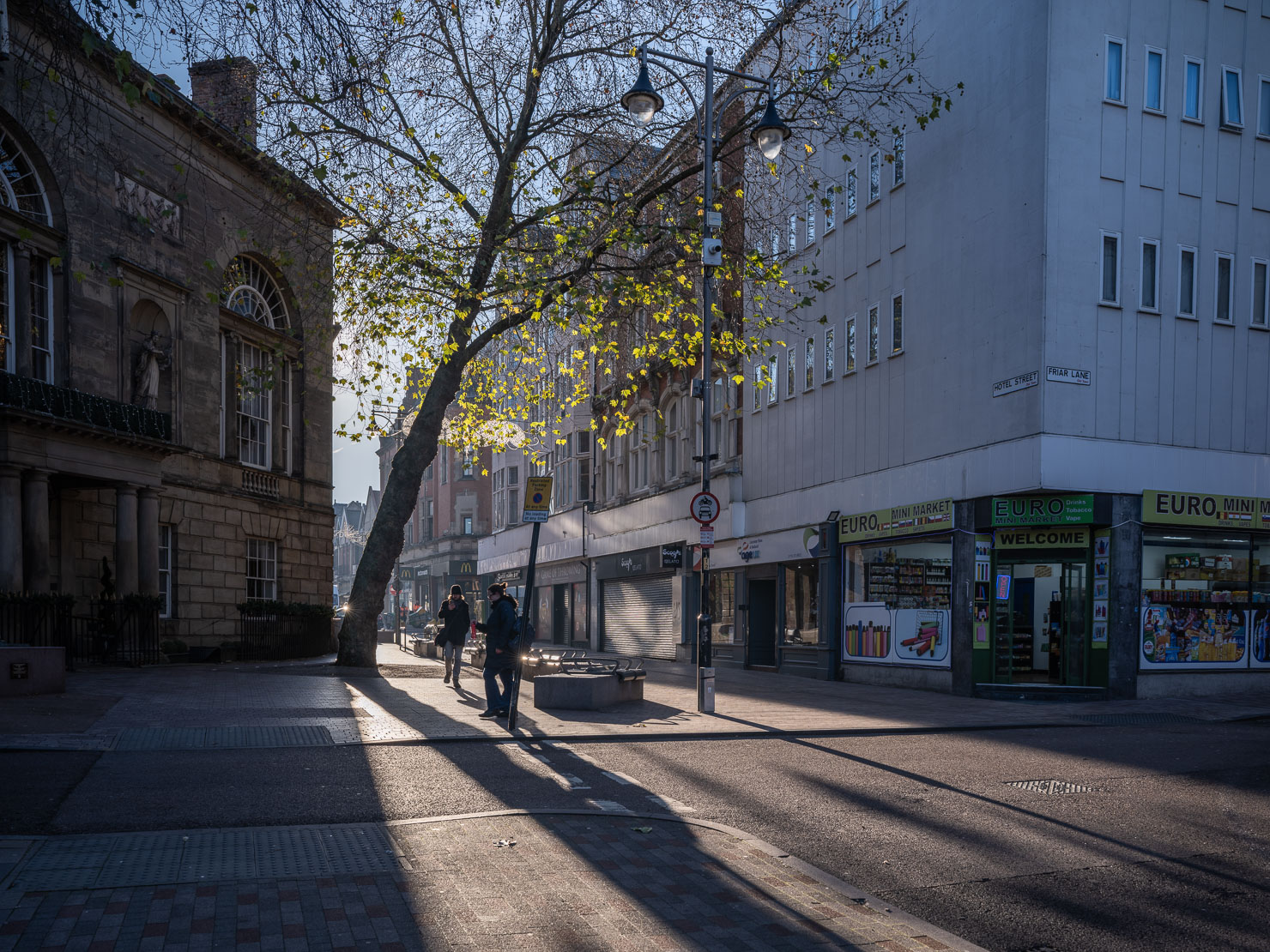
The lens gives good contrast to backlit subjects – just keep the sun off the front element.
And a 50% detail crop [these are from 100MP images].

The fountain at Leicester Town Hall.

Detail [100%]

This view is just shy of full [12mm] vertical shift, note the darkening of the edge of the image circle at the to. Not every shot will show this – it depends on what’s in the image.
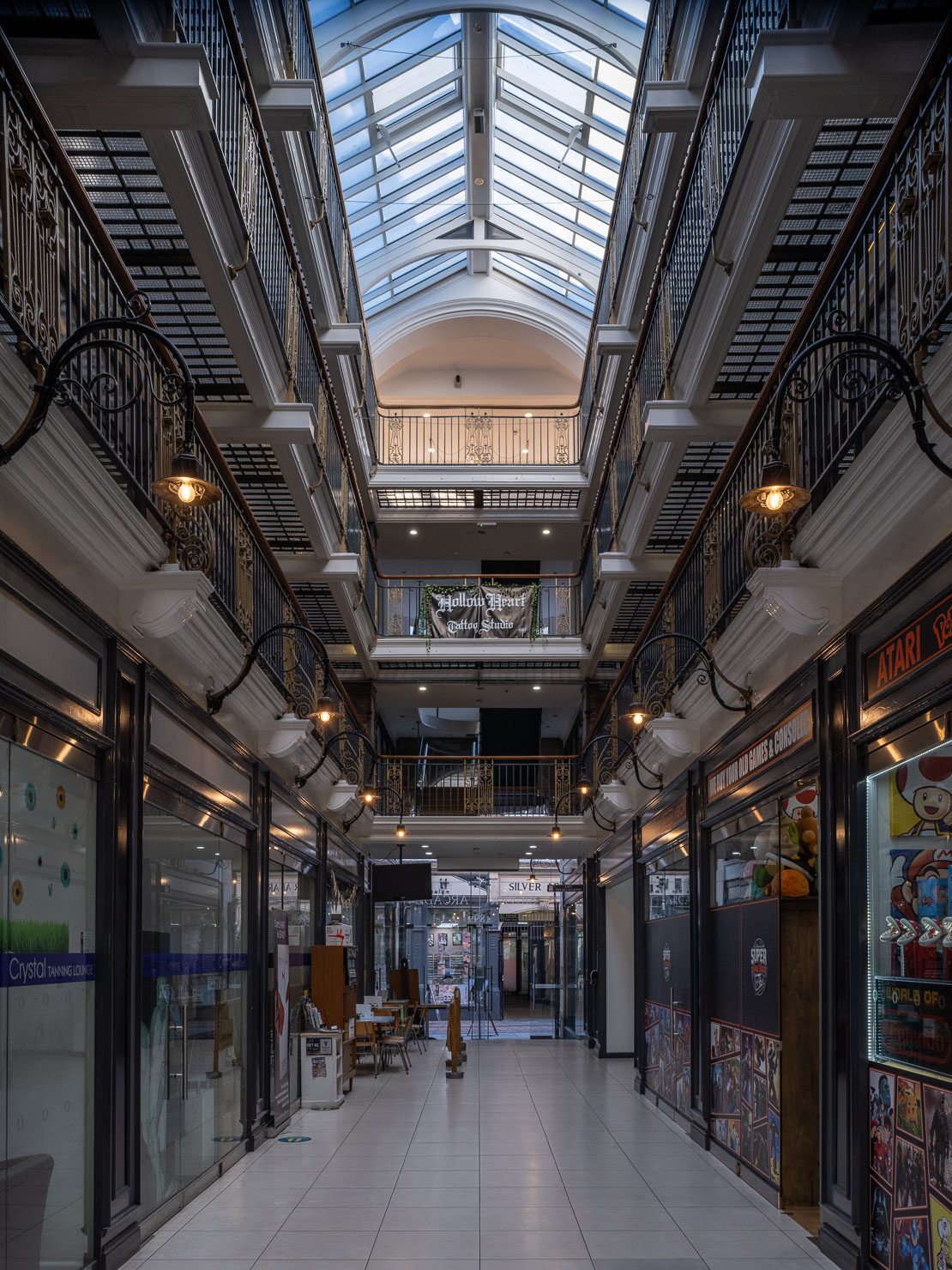
With shift, the lens is quite wide on the GFX

Shift and stitching on the Laowa 35mm tilt shift
Using the lens foot to keep the lens fixed, you can shift the camera, take multiple shots and stitch the images.
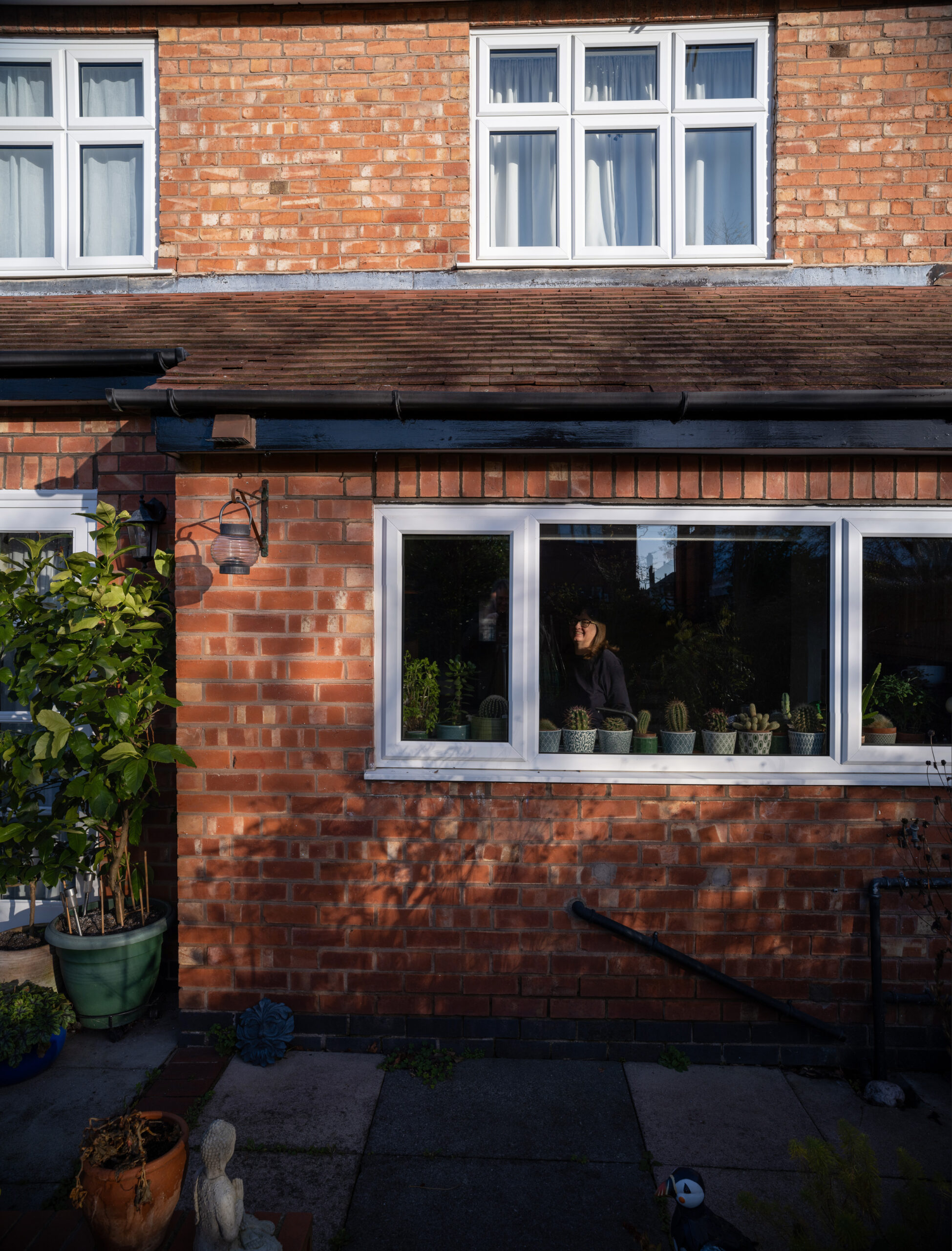
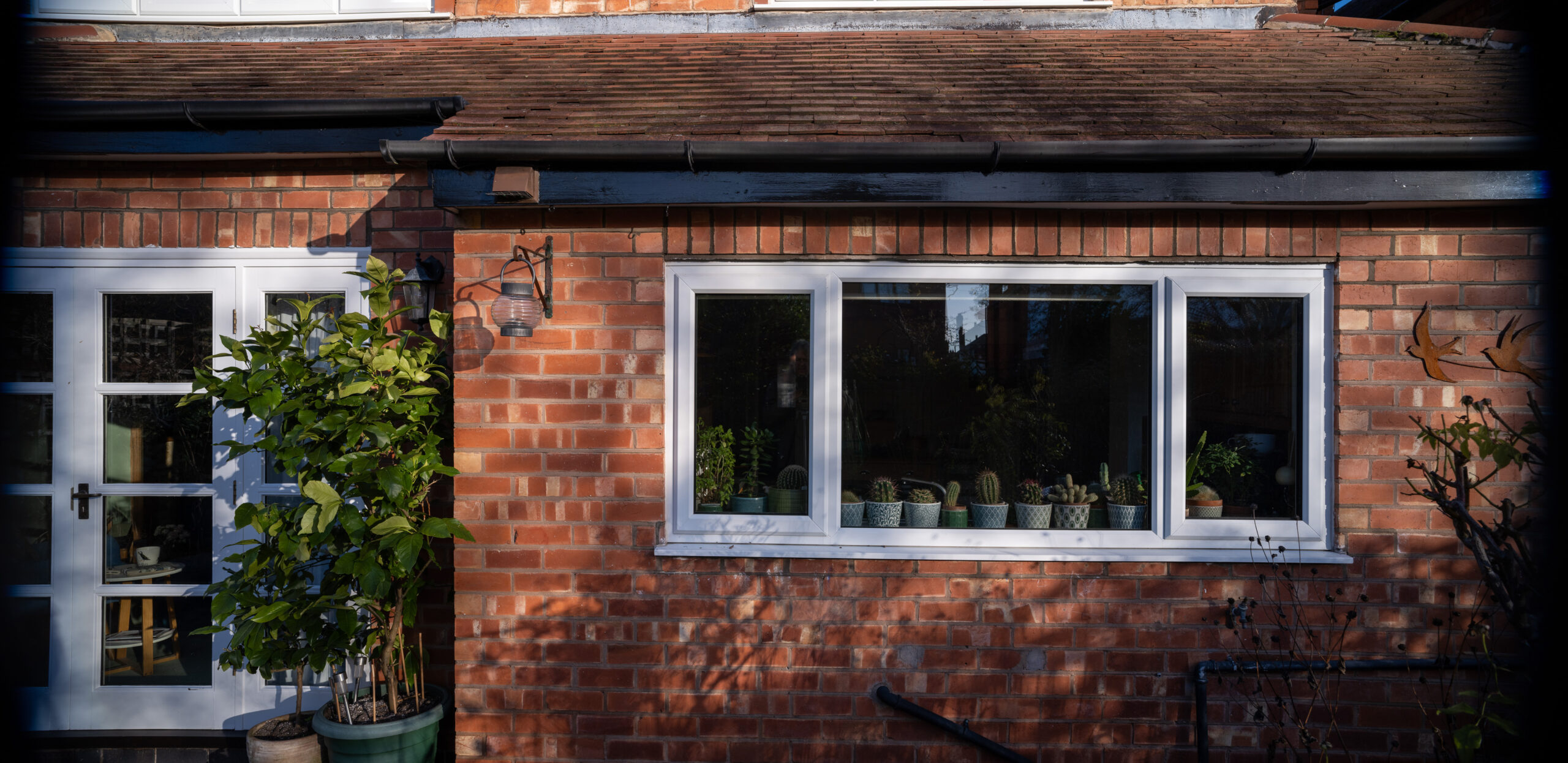
Here’s two views of the back of our house with two vertical and two horizontal images shift/stitched.
First an up/down stitch – this is ±10mm Notice the fall-off in the corners.
Next left/right. This is the full±12mm -you can really see the edge of the image circle
Just for good measure, here’s the process with the camera set to 35mm crop mode.
This is what you’d get with ±12mm on a full frame sensor.

With the lens foot, there is no chance of stitching errors due to parallax, but if using the lens [or any shift lens] for left/right shifts do remember the edges will be in areas of lower quality [much less noticeable on ‘full frame’ sensors].
Tilting the Laowa 35mm tilt shift
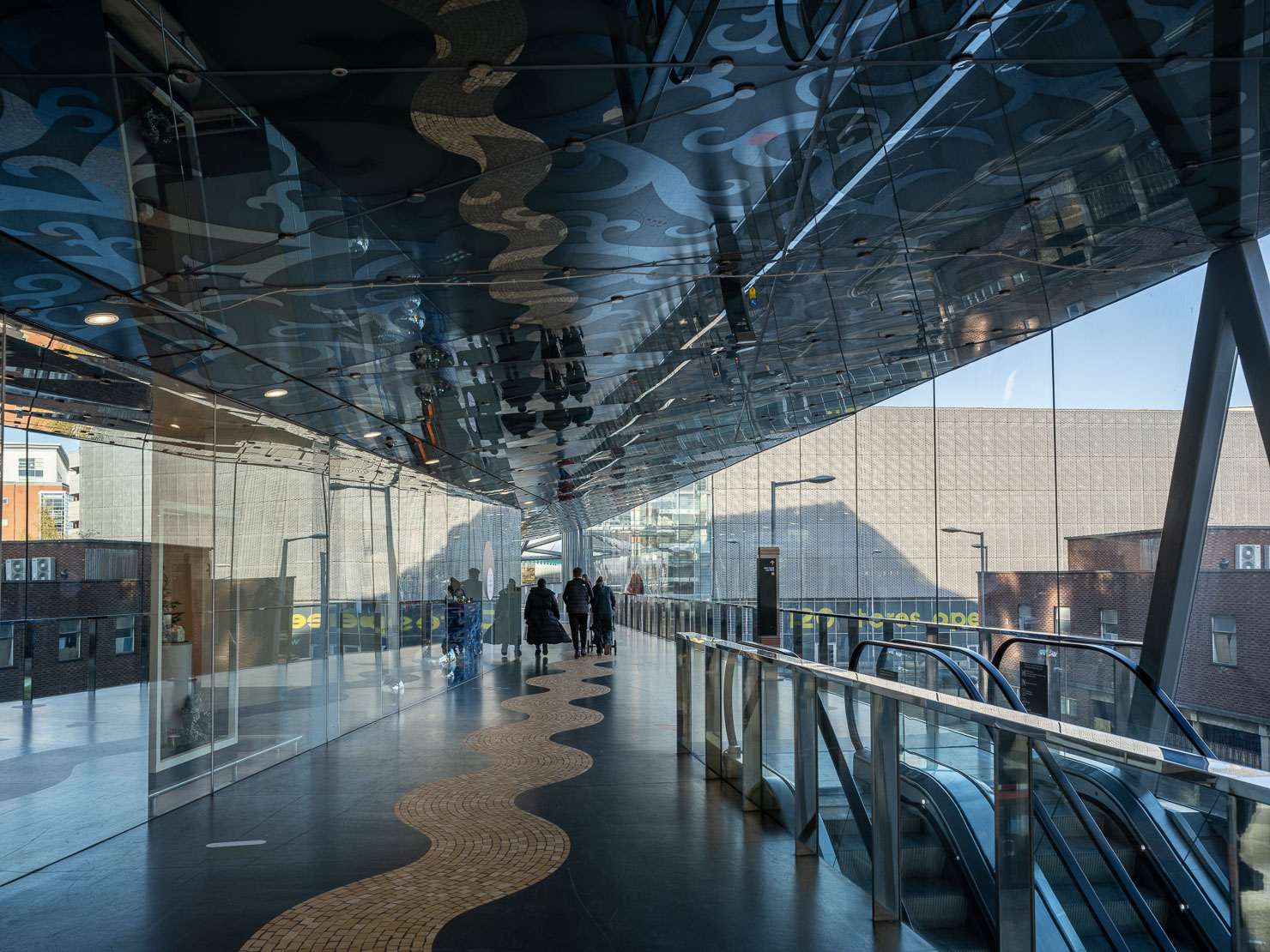
Two shots from nearly the same location. In the first, just a normal shot at f/8 giving a nice view of a walkway at a shopping centre.
In the second – what has happened to the focus?
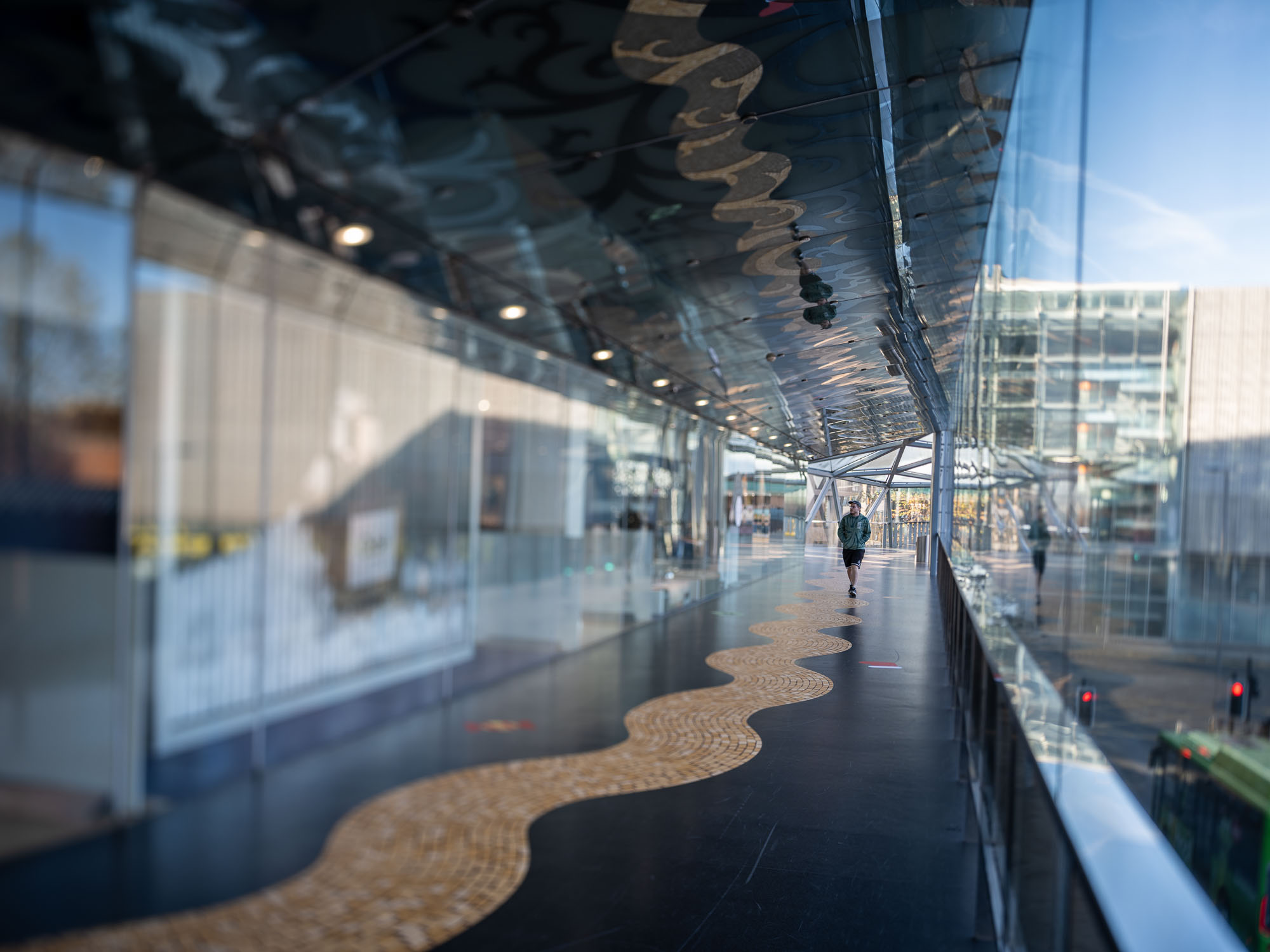
This is a shot with the lens tilted fully to the right, then using the focus ring to swing round the now vertical plane of focus down the walkway – making sure there is someone in the plane. I’ve used f/2.8 to show the effect more clearly.
Here’s a crop at 100%.

The plane of focus is really quite narrow. Remember too that it is actually a ‘wedge’ of focus, so very thin [at f/2.8] close to the camera, thickening as you move away.
Shooting a f/16-22 thickens the plane of sharp focus makes the use of tilt much less obvious, but it’s still a wedge of focus.
At strong tilt like this it’s worth noting that the style of out of focus areas is asymmetric. There is also a potential uneven darkening of images [left v right in this instance] if you shoot at widest apertures.
Remember that the physical design of the lens limits tilt and shift use at the same time, and the axes of shift and tilt are fixed relative to each other, although the whole lens can be freely rotated on the mount.
These two [hand held – click to zoom] examples show the difference at f/8, using a bit of rightwards tilt to keep some of the grass in focus.
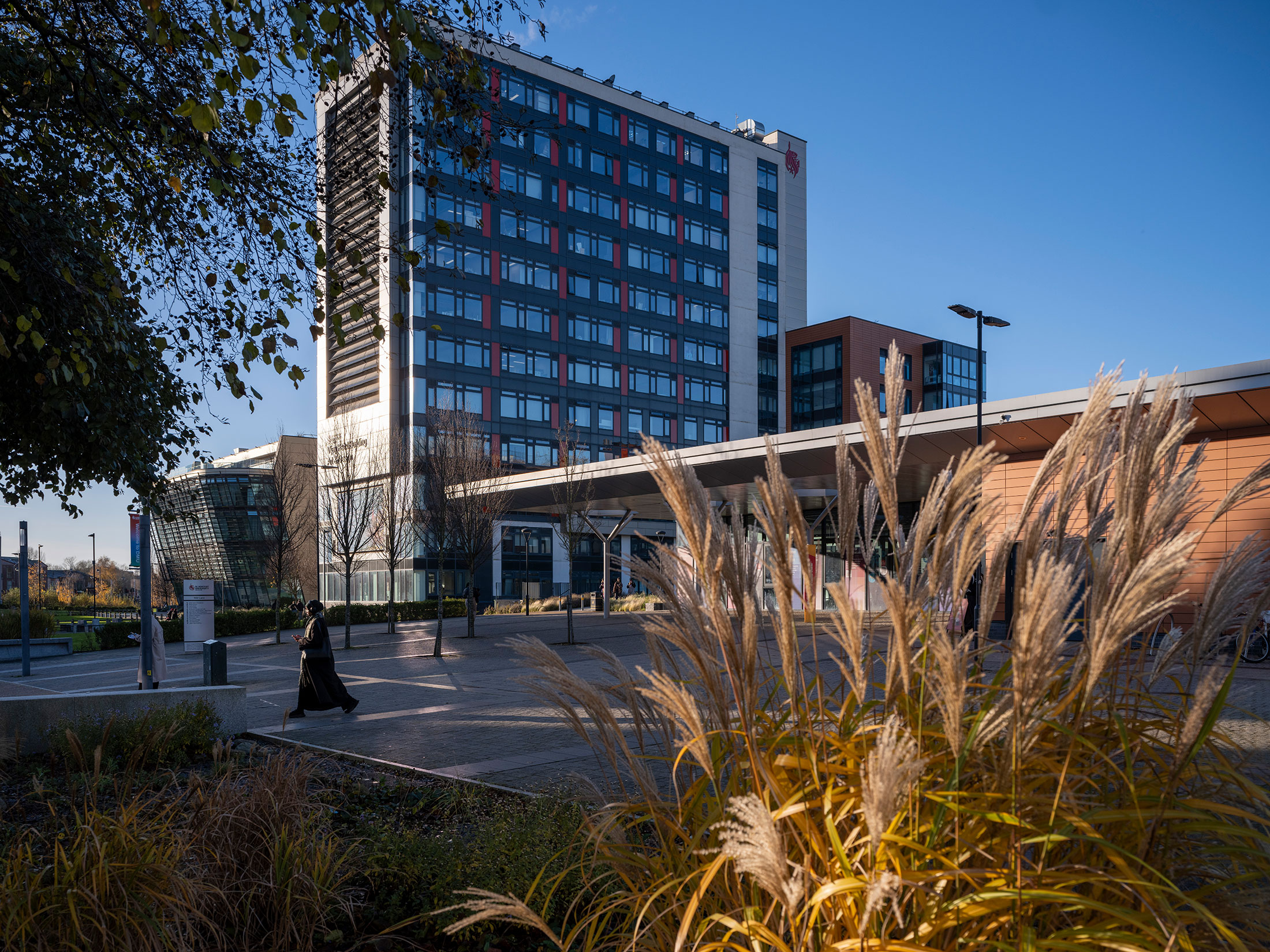
f8 – no tilt
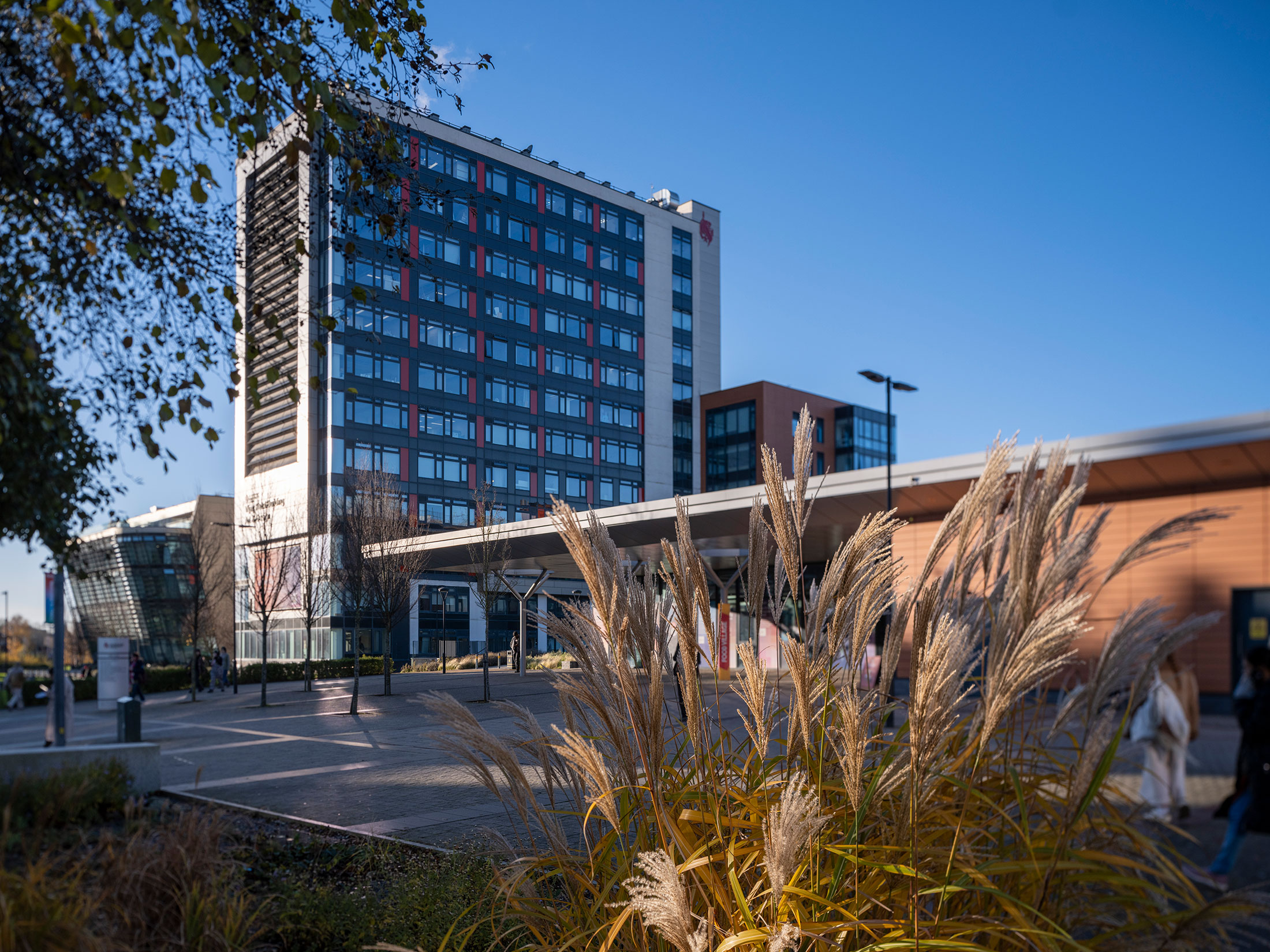
f8 tilt to right
Note how, even at f/8, only part of the building is sharp.
This is partly why use of tilt with lenses like this, for landscape photography, often fails to give the ‘magic DOF fix’ some hope for when getting tilt/shift lenses.
Close up with the Laowa 35mm tilt shift
The lens focuses close enough 1:2 magnification [0.5x]. If you were wondering about using extension tubes, the plane of focus [working distance] is already close enough that the lens could shadow the subject.
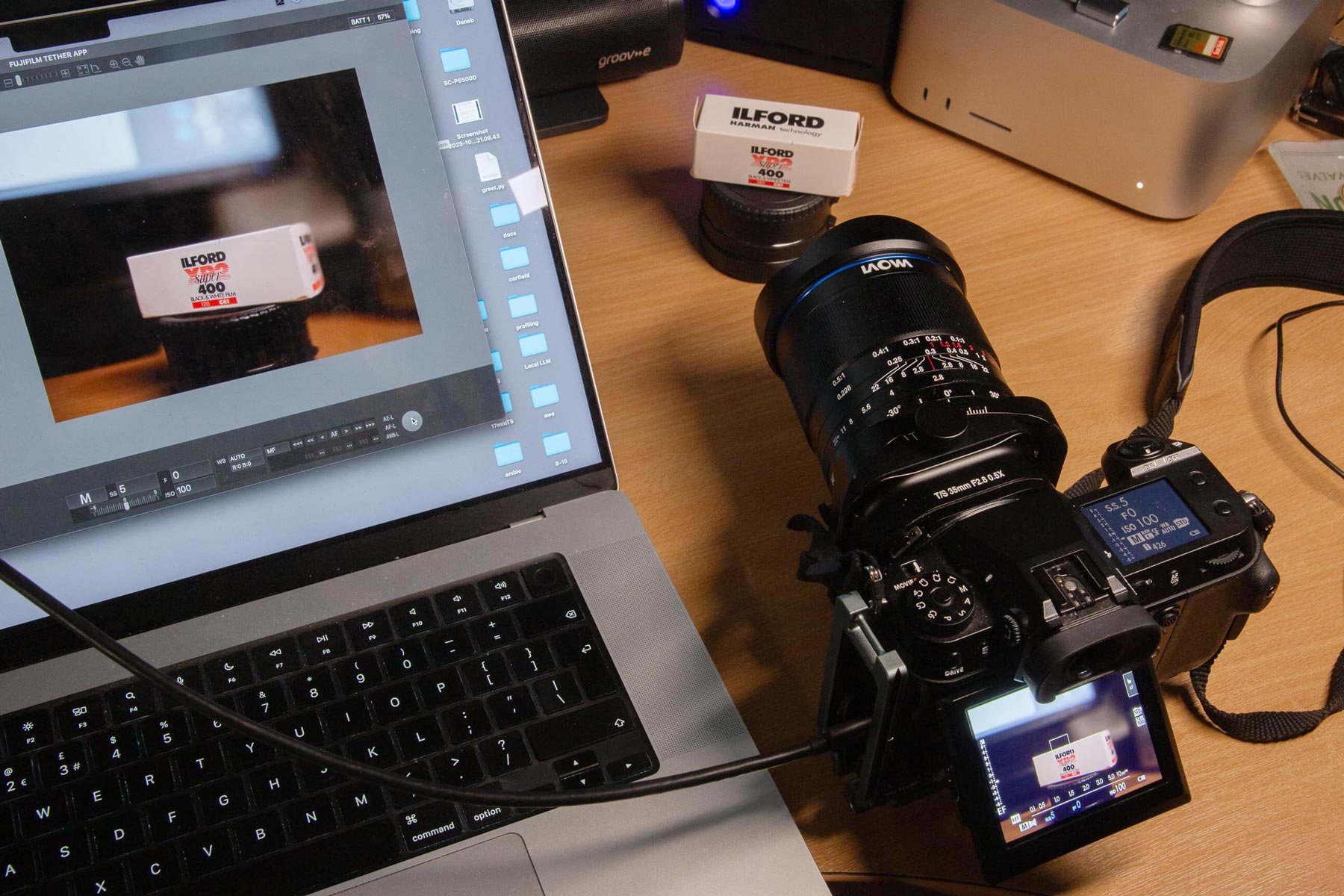
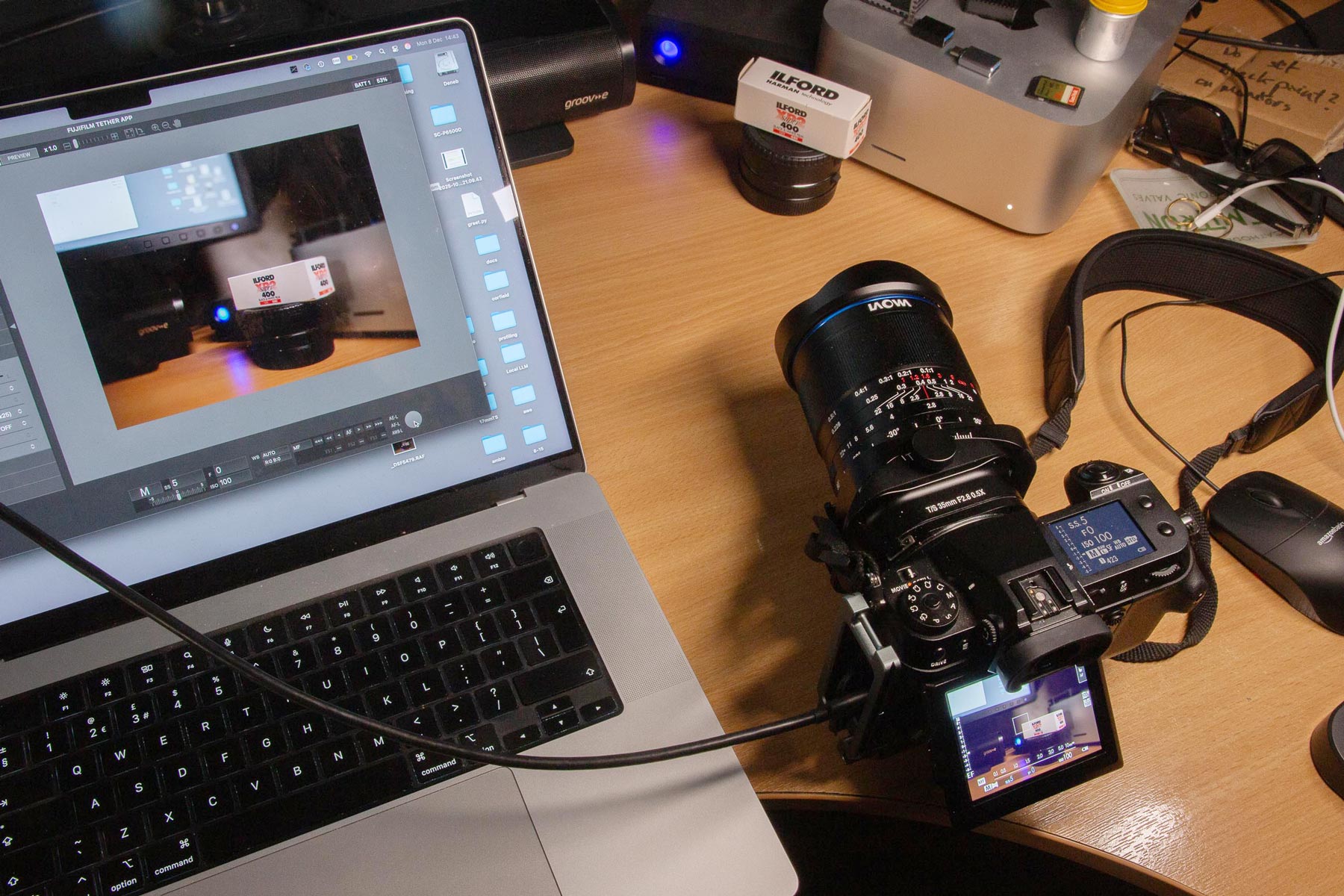
The examples below were shot with the GFX100S tethered to my laptop [Fujifilm Tetherapp].
First up, the closest you can focus.
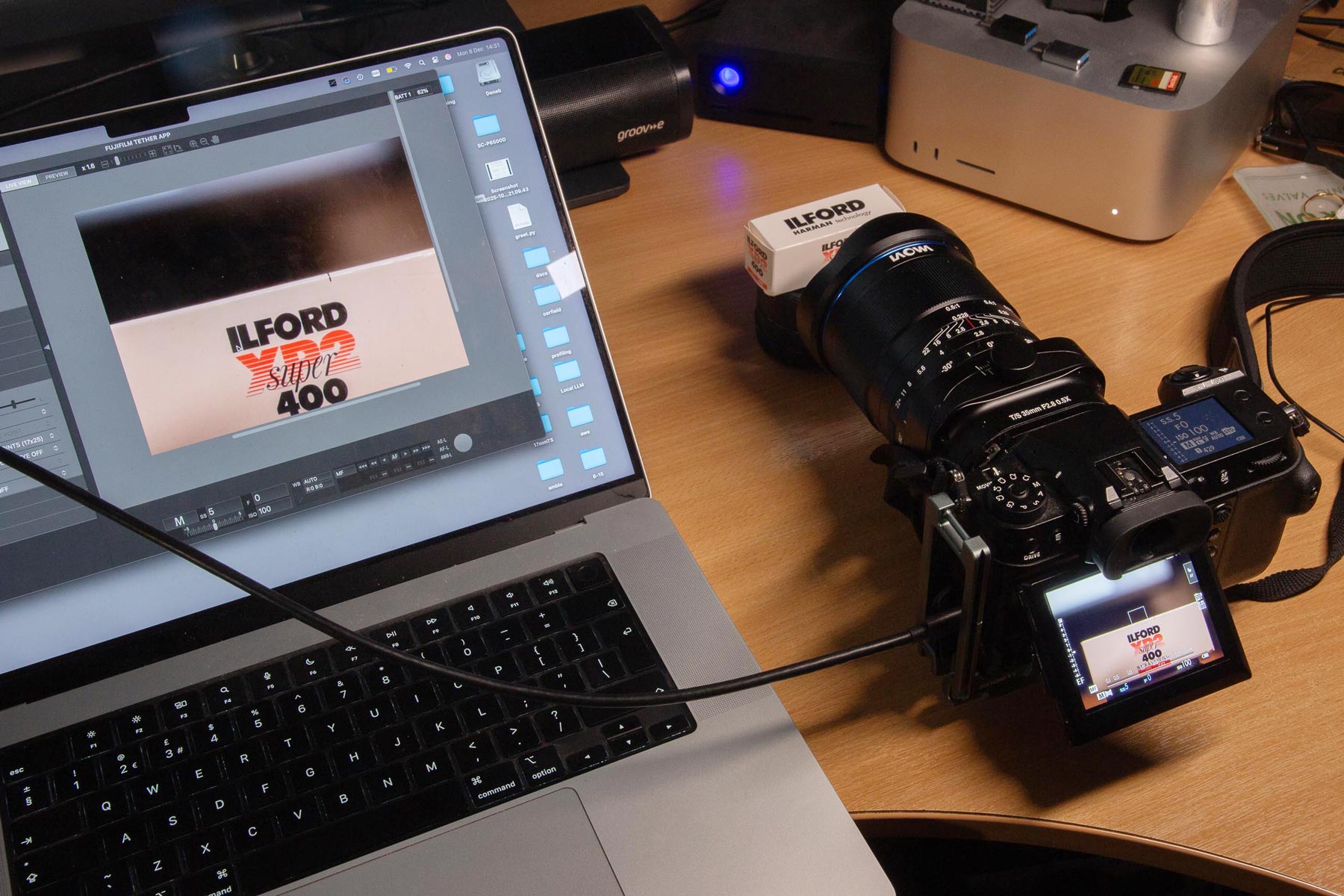
Now with the full 10º of tilt.
Note how the tilted plane of focus is further away from the camera. The amount of tilt of the plane available is reduced as you focus closer.
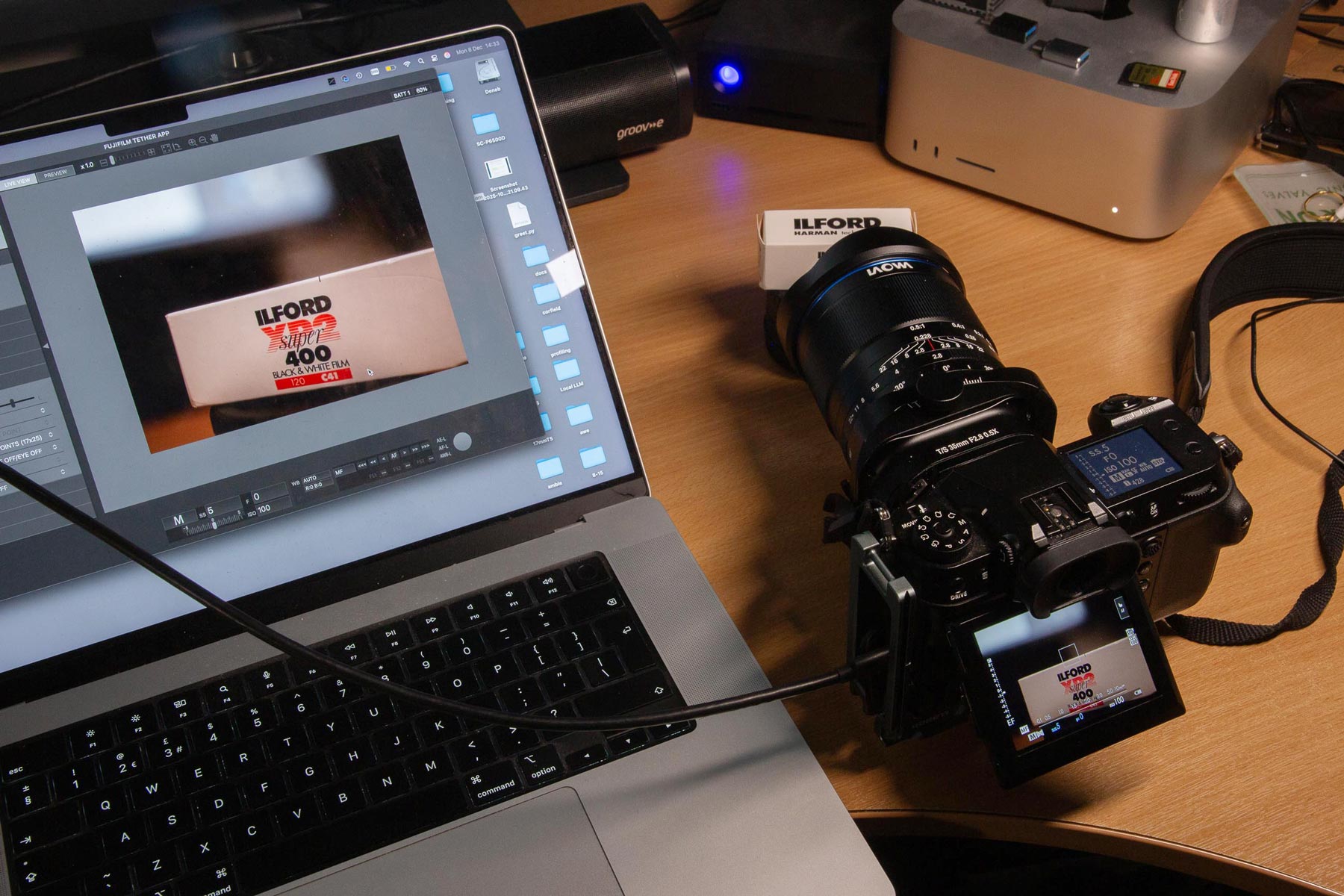
With the subject further away, the 10º of tilt shows a more pronounced movement of the plane.
A third tilt example, still with the maximum 10º of tilt shows a lot more effect.
You can also see how lens tilt can shift where the subject is relative to the camera.
If the lens had the ability to shift left/right here, I might use a bit of shift combined with the tilt for framing and composition.
As it stands, you can’t do this due to the locked shift/tilt axes orientation [you can on the similar Laowa 55mm and 100mm TS lenses].
I note that the lens shift and tilt sections are attached together by four screws. This reminds me of my original TS-E90 lens where I modified the tilt/shift axis alignment. That could be modified by Canon [or myself – see this example]. Since this isn’t my lens I’m not taking it apart to see though. I suspect the large/close rear lens element precludes this.
Thoughts and conclusions: Laowa 35mm tilt shift
35mm is one of the focal lengths ‘missing’ from current Canon/Nikon tilt shift lens line-ups. On full frame camera it gives a more natural feel [even with strong shift] than say 24mm, such as the TS-E24 F3.5L I’ve used for many years for my architectural photography [with DSLRs such as the 1Ds mk3 and 5Ds]
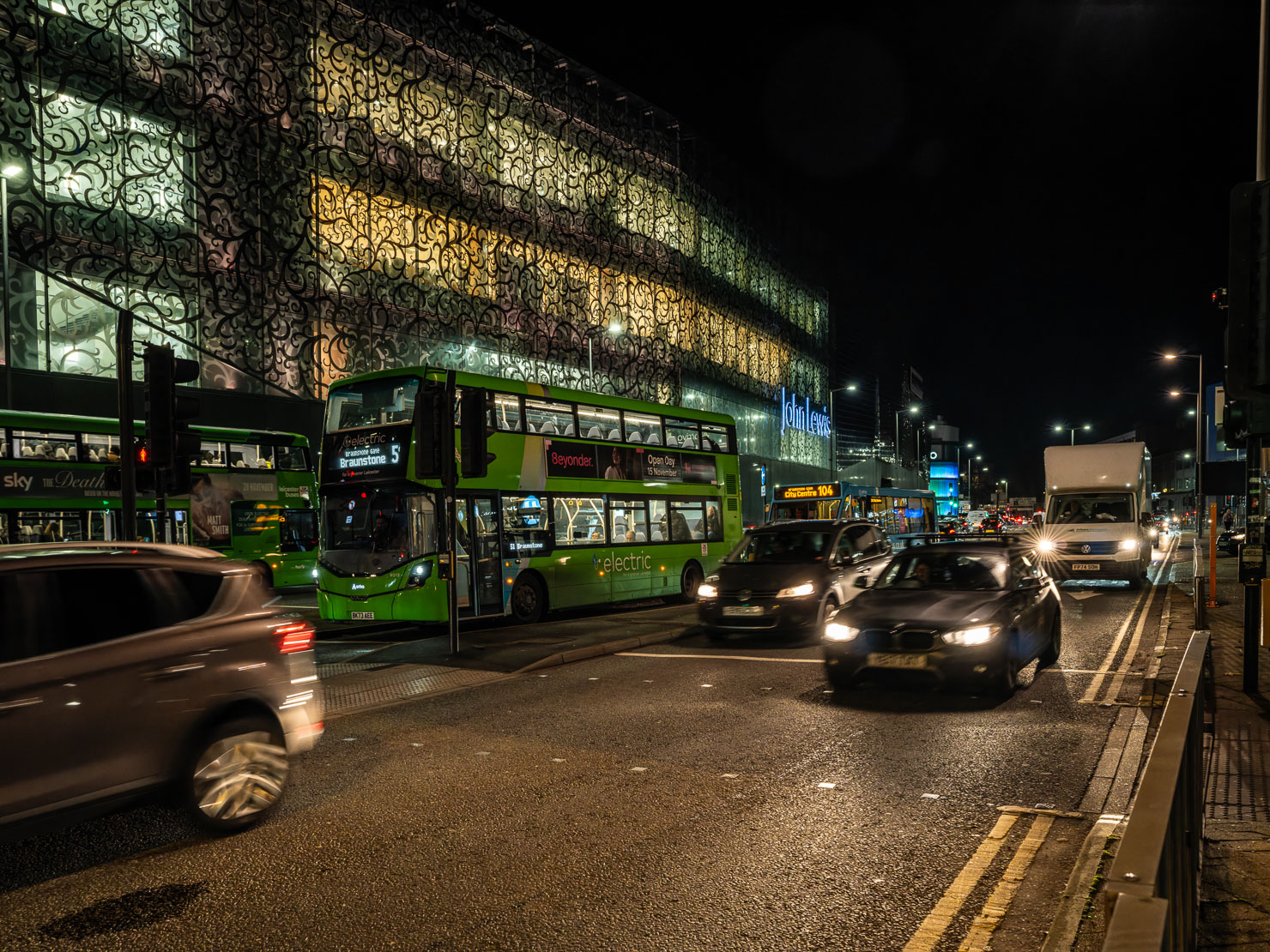
This shot, with a few mm of vertical shift gives a nice feel for the scale of the scene without looking excessively ‘wide angle’.
In fact the 35mm focal length is often achieved [on ‘full frame’] using the Canon TS-E24 with a 1.4x teleconverter. I’ve done this a few times in the past on my Canon 5DS, but it had to be where I specifically wanted 35mm.
I have compared the Laowa with this combination and I’m fairly convinced the 24mm+1.4x solution is poorer in image quality, Decidedly worse geometric distortion [likely due to the 1.4x TC] and softer towards the edges. See the two examples just before the videos below. However, whilst I’ve posted some examples on the MF forum at DPReview, I’ve not included all of them here, since my TS-E24 had a bit of a knock a while ago and possibly needs servicing [that wouldn’t affect the geometric distortion – just edge quality].
I’ve used the TS-E24mm a lot over the years on my 1Ds Mk3 and 5DS, and my Fuji 30mm tilt shift gives a similar FOV on my GFX100S. The Laowa 35mm on the GFX gives a roughly equivalent FOV to 28mm on full frame.
Feel and handling
The lens is very solidly built. Focus action is smooth although I’d prefer slightly more tactile feedback from thicker knurling on the focus and aperture ring.
The lens foot gave me no problems during use, although I reversed it to place the foot closer to the centre of gravity of the lens/camera. Make sure you tighten the screws well – I might even have put some non-permanent thread-lok on the screws if it wasn’t a loan lens which had to be returned.
Movements are free, once you release the locks. I’d say they were a little too free, with the shift making the camera/lens likely to drop quite easily to full shift [for up/down orientation]. Where this could be a problem is that people will over tighten the locks, and this is a common problem for such lenses [of all makes]. Whilst there is a faint zero shift point detent, there isn’t one for tilt, so if not using tilt, make real sure you have not accidentally left the lens with a fraction of a degree of tilt. since that will affect image quality.
Optically, the lens is great to use – the full frame versions will give fully usable shift and are much less likely to show any edge/corner issues at full shift. That said, stick to ±8mm of shift on medium format sensors and you should be fine. Of course, the rather loose shift movement means that precise setting of shift is not as easy as it could be.
With the GFX100S, the combination makes for a hefty bit of kit – I was OK using the lens hand held [sensor IS can help a bit] and at night.
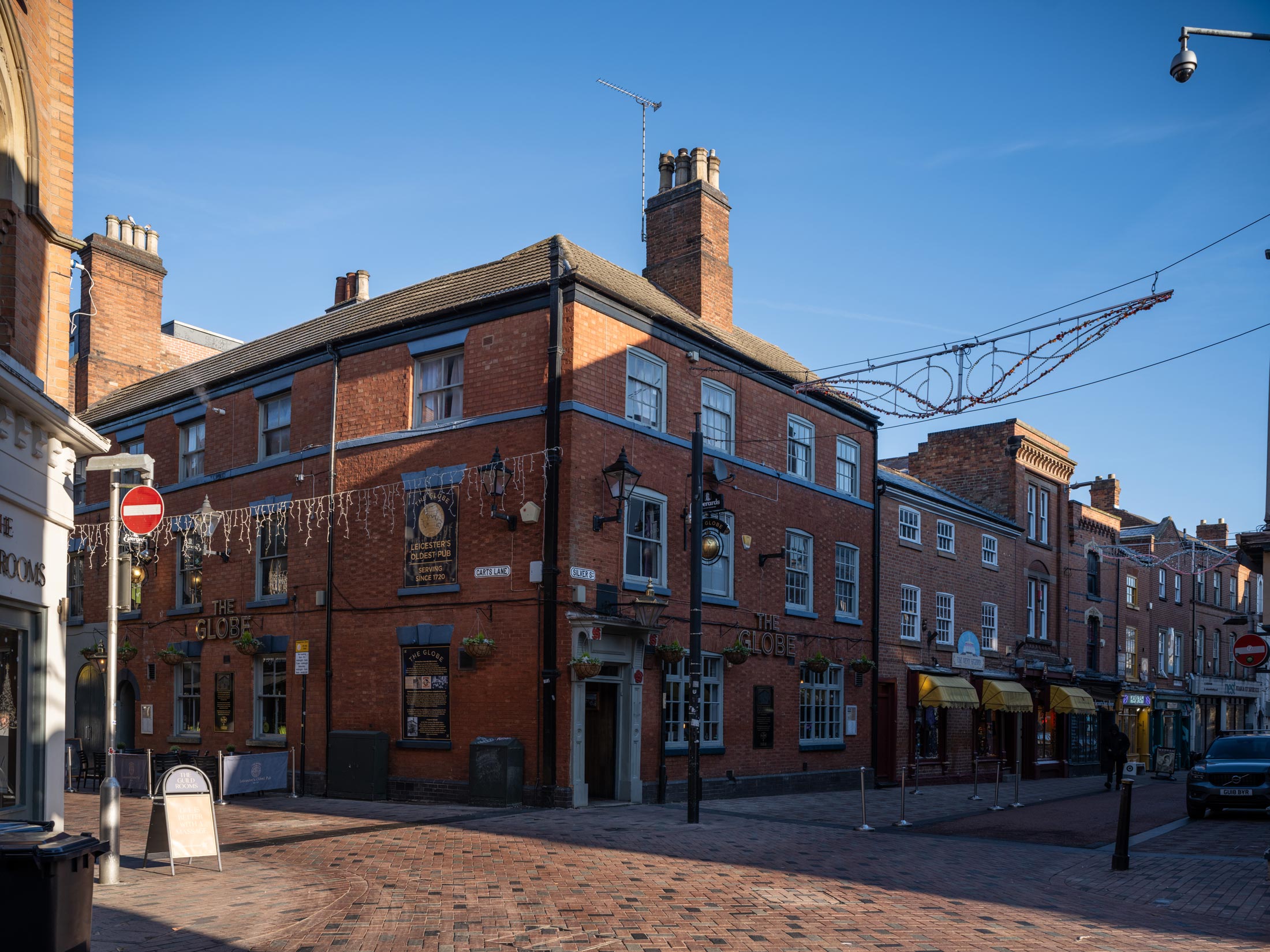
The Globe pub, Leicester – serving beer since 1720
Is it for you?
It’s a big lens – no problem here, since I’m an architectural and industrial photographer and I’m used to such things. Nor do the fully manual operations and lack of electronics bother me at all.
Optically I’ve no real issues with the lens, and any softening/vignetting was only really an issue when I was pushing beyond the ±8mm suggested limits for the larger 33x44mm sensor.
If you regularly use a 35mm focal length from a combination of 24mm and a 1.4x converter then this really is a lens to consider.
The weaker points [as with the similar Laowa 55mm and 100mm tilt/shift lenses] will be the nature of the movement controls, a lack of smoothness and subtlety and maybe the limitations on setting tilt and shift at the same time [that’s the 35mm, not 55/100]
Looking at the 100mm f/2.8 tilt shift for example [it does 1x macro], the tilt and shift axes can be changed relative to each other. Looking inside the 100mm, you can see a lot more space between rear element and the mount. Then again, do I want macro in a 35mm? The 100mm has much more working distance…
I’ve also included some videos looking at the 100mm and 55mm below FYI.
Review: Laowa 35mm TS f/2.8 Tilt-shift 0.5X Macro Lens: pros and cons
Pros
- Excellent optics
- Solid build
- Wide range of lens mount options
- First 35mm tilt shift lens for many years. Not found in the Canon/Nikon range
- Lens foot reduces parallax issues
- Good value, especially for Medium Format
- Lens rotates on mount and in lens foot for tilt/shift in any direction/format
Cons
- Fully manual operation may discourage some
- A bulky lens – aimed at serious use
- Shift and tilt mechanisms could do with mechanical refinement
- Some limitations on using tilt and shift at the same time
- Shift/tilt axes set in alignment
If I didn’t already have the [much more expensive] Fujifilm 30mm tilt/shift [30mm TS review] I would happily use this lens for my professional work.
Learning more about tilt and shift?
There is a Tilt/Shift index page covering much of my related info on this site.
There is a full index of all my 60+ tilt/shift related videos on my detailed video index page.

My book about using tilt/shift lenses is now available.
If not in the UK check for import issues and maybe try an on-line bookshop.
Compared with TS-E24 and 1.4xTC
A couple of quick comparisons shots [unshifted and +12mm shift for the TS-E24 and converter
These are shot on the GFX100S, so mentally crop them to visualise the FOV on a full frame camera. Remember that the TC is very much not designed for use on a medium format sensor, so whilst the barrel distortion would still be there, it would be nowhere near as obvious.
There is a general barrel distortion I don’t see from the TS-E24 on its own [I’ve used this lens for paying work since 2008!]
The TC ‘amplifies’ the 12mm of shift to give a wider apparent shift.
Once again – on the larger 33×44 sensor, so results would be more acceptable on full frame.
Still far more distortion than I would like for anything but occasional use. There is no ‘auto’ correction available for any shift lenses [the one exception being using the Fuji 30TS with C1 to process the images].
Main review video [37 mins]
lens testing videos – testing with my GFX100S
There is a set of full size samples in a thread on the DPReview Medium Format forum
Additional Testing showing shift on MF and FF sensors
Laowa 55mm tilt shift review [51 mins]
Laowa 100mm tilt shift overview [20 mins]
Never miss a new article or review - Sign up for our occasional (ad-free) Newsletter
and please do subscribe to Keith's YouTube Channel

Other areas of our site that may be of interest...
All the latest articles/reviews and photo news items appear on Keith's Photo blog

Keith explains tilt and shift lenses
Keith has written a book that looks at the many ways that tilt/shift lenses can benefit your photography from a technical and creative point of view. If not in the UK check for import issues and maybe try an on-line bookshop. Keith has no connection with sales of the book.
ISBN 9781785007712
There is also a specific index page on the site with links to all Keith's articles, reviews and videos about using tilt and shift.
We've a whole section of the site devoted to Digital Black and White photography and printing. It covers all of Keith's specialist articles and reviews. Other sections include Colour management and Keith's camera hacks - there are over 1200 articles/reviews here...
Adverts removed