


Laowa KX800 Flexible Macro Twin Flash review
Venus Optics Laowa KX800 Flexible Macro Twin Flash Kit
Flexible twin macro flash review

No more Google ads. Too many deceptive and irritating adverts.
Any ad links left are non tracking, to companies we know, trust and we've worked with for years [Park Cameras]
Ads helped pay for site running costs, so if you found something useful, please
...Make small KoFi donation?
...Subscribe to Keith's YouTube Channel
...Get Keith's book about how to use tilt/shift lenses
Our site contains affiliate links - these help support the site. See our Advertising policies for more
Keith looks at a relatively inexpensive twin flash unit for macro and product photography.
The Laowa KX800 unit is unusual in twin flashes in that the flash heads are mounted on stiff flexible supports. A powerful LED focus assist lamp is provided via a central flexible ‘stalk’.
Check for worldwide delivery/pricing at
Venuslens.net
Article Index

Learn to do your own product photography. Northlight offers on site product photography workshops in the UK.
Laowa KX800 Macro flash
I’ve used the (rather more expensive) Canon dedicated MT-24EX twin macro flash for some time, which has a dedicated attachment disk that fits on to the front of lenses such as my TS-E90mm and MP-E 65mm.
It works well, but to get the flash heads away from the lens I use clamps with flexible flash attachments on them. Great if I’m setting up a studio shot for focus stacking, but much less practical for general use, such as photographing small parts of machinery in situ.
What do you get
The flash attaches via a normal hot shoe connector and is entirely manual in its setup
 Specifications
Venus Optics Laowa KX800 Flexible Macro Twin Flash Kit
- Circuit Design – Insulated Gate Bipolar Transistor(IGBT)
- Guide No. – 58 (in meter), 190 (in feet)
- Horizontal Rotation Angle – 0~270 degrees
- Power Supply – 4x AA size batteries
- Battery life – 100~1500 times(Alkaline cell used)
- Recycling time – appr. 2~5s(Alkaline cell u
- Colour Temperature – 5600k
- Flash time – 1/200s ~1/20000s
- Flash Control – 8 levels of output adjustment per flash unit
(1/128~1/1) - External connection – Hot shoe, PC port
- Compatible with – Canon, Nikon, Sony A, Pentax (Selected Sony E mount cameras require an adapter)
Using the Laowa KX800
The KX800 is shown here on my Canon 100D
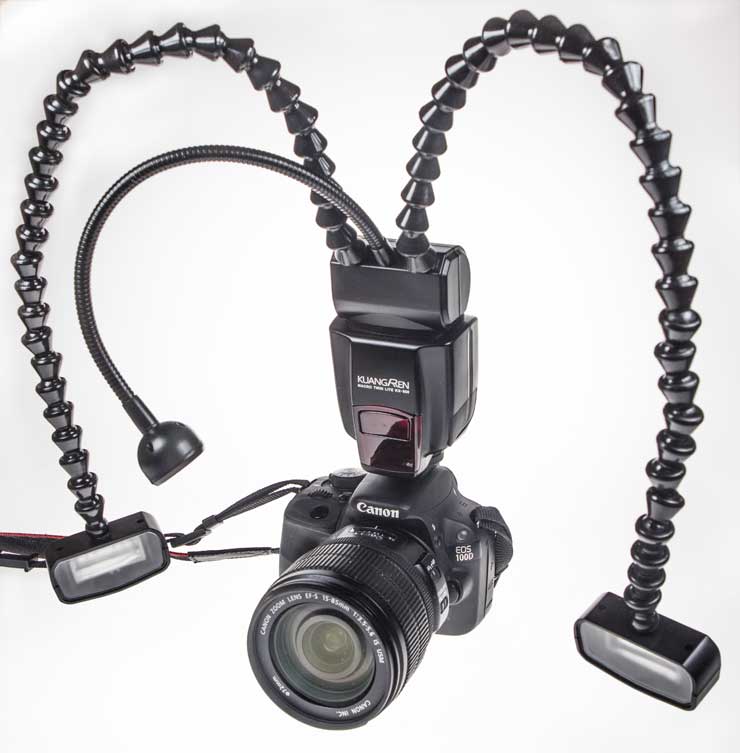
Laowa kx800 on Canon 100D
Note the red plastic plate – there is nothing behind this, it isn’t a light or sensor. The name on the case is KuangRen – I don’t know what the significance of this is.
The LCD on the back shows relative flash power and the intensity of the focus light.
In this case both left and right flashes will fire at minimum power – the assist lamp is off.

The assist lamp is quite powerful. Here at less than 1/3rd power, lighting the mode dial of the camera.

Note how the flash is now split, with the left light at 4 stops brighter than the right. You can also set a flash to be off.
The supports for the flash heads are quite flexible, but be careful not to rotate them too far from their initial positions. Such use might not cause immediate failure, but twisting the wires inside too much won’t do the unit much good.
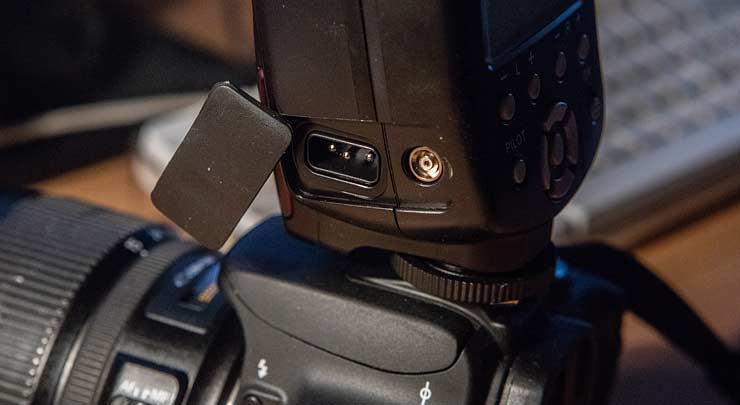
There are side connections for flash control and external power.
Diffusers
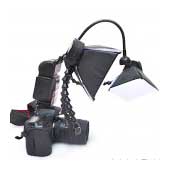 The Laowa web site shows small ‘softbox’ diffusers as an optional accessory for the KX800, but we were unable to test them at this time.
During Karen’s testing of the flash for her jewellery work she found that a small piece of cloth attached to the flash head with an elastic band added just that extra bit of diffusion to soften shadows.
UPDATE – after testing, we purchased a KX800 for Karen’s work, and were able to get the softbox units.
They are light and work very well, giving a much softer light. They attach to the flash heads with Velcro and a thick rubber band. They pack flat when not in use. The assembly needs a few moments thought as to getting best fit, but they are a useful accessory.
Here are the diffusers fitted to the flash.

Shooting products
Karen also uses the Northlight kit for her UK jewellery business and took the chance to try the KX800 instead of her usual setup, using the Canon MT-24EX.
For some simple test shots, she needed a collection of beads for some background images.
The setup, in her office, uses a simple sheet of white plastic clamped to the front of a desk.

The two flash heads are set to different power levels. The focus lamp is being used to add extra ‘sparkle’. The amount depends on its placement and exposure, hence the darkened surroundings (darker than it shows in the photos).

This section of a bridal tiara [aka Alice Band] shows reflections of the lights in the pearls – both heads are covered with diffusing cloth, just enough to smooth the reflected highlights.

Note the darker shadow to the left of the tiarra – this shows that the left flash head was set to a slightly lower power.
Once she has taken some shots with the diffusers fitted, I’ll add an another example shot.
Outdoors
I know a lot of people like using macro for insects and flowers and will want to see how the flash works in that area.
Much like my professional macro work (small engineering samples and components) I know this takes a lot of practice to get right, so I’m not going to try and produce stunning bug photos…
For a lens I’m using my TS-E90mm lens with a 26mm extension tube. This gives a useful magnification on the 100D and keeps the subject at 4-6 inches from the front of the lens.
Here’s the camera, sitting on top of the Canon PRO-2000 printer I’m currently testing.
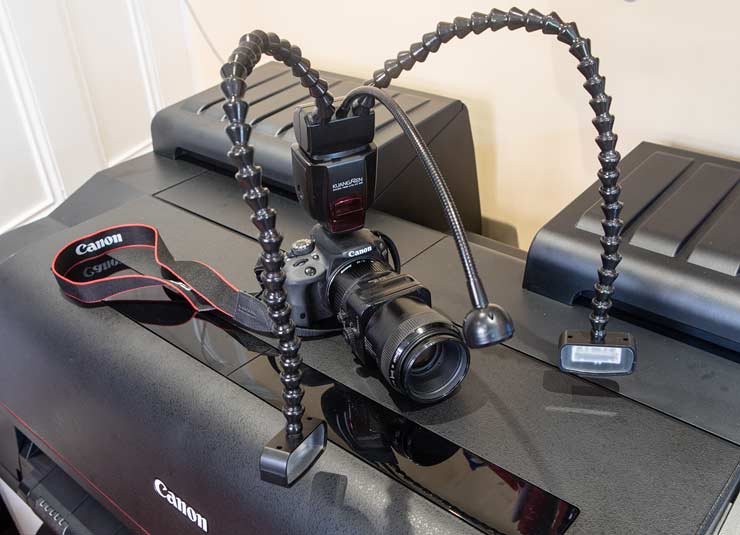
When working outdoors you need to decide how much part natural lighting is going to play in your photo.
With a small aperture, the lights are easily powerful enough to render the background dark, in bright sunlight.
The problem is likely to come from the flash sync shutter speed limit of your camera.
With the 100D I can set it at 1/160 and still get even illumination from the flash. So for a setting of 100ISO I’m needing f/11 or f/16 for the daylight not to over expose the image.
Now, since I’m using an extension tube, the effective aperture is smaller than indicated anyway, which helps if I want a darker background.
The upshot of this is that if you want to shoot flash outdoors on many cameras, with just the light of the flash (for dark background or motion freezing), you may need an ND (neutral density) filter. This allows you to use wider apertures, which will also reduce the softening effects of diffraction. The KX800 is powerful enough to handle several stops of ND filter in this case.
If you’re not familiar with some of the uses of ND filters, see my review of a variable ND filter from MPB.
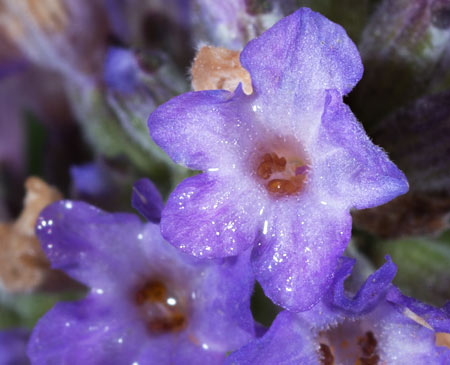
A simple example shows a flower head on a lavender plant, in bright sunlight.
One shot is at f/11 and the other at f/9. The flash is set at a higher power for the f/11 shot. Both are at 1/160.

At f/9, the shadows from the sunlight are more obvious, and the background is brighter and slightly softer.

It’s up to you to decide how best to match flash and available light, but the point is that the KX800 has the flexibility and power to cover what you need.
Conclusions
Buying the Flash
We make a specific point of not selling hardware, but if you found the review of help please consider buying a lens, or any other items at all, via our links with Amazon or others.
Check for worldwide delivery/pricing at: Venuslens.net
The Laowa KX800 looks a little ungainly at first, but is actually rather robustly put together. The stalks supporting the flash heads are stiff enough to stay put once moved. At nearly half a metre long they give a good range of creative lighting options, including back lighting for close-up items.
Do be careful though not to rotate the heads too far (beyond 180 degrees I’d say) from their original positions. The wires connecting the heads to the body will fail if overly stressed. This doesn’t seem a problem in normal use, but very much a bit of kit to be kept away from (small) prying hands.
At less than full power, the flash recycled fast enough to hardly notice a delay. Indeed the power of the unit was such that I very rarely had it set at full power.
The focus lamp is surprisingly bright and can be used to give extra light at low flash power levels (the extra blue/white sparkle made a difference to some of Karen’s jewellery shots.
A distinctly useful bit of kit and priced low enough to encourage experimentation in macro work.
Summary
A dual head flash with independently adjustable heads on stiff but flexible stalks. Variable flash power and an independent adjustable LED focus assist lamp.
Never miss a new article or review - Sign up for our occasional (ad-free) Newsletter
and please do subscribe to Keith's YouTube Channel

Other areas of our site that may be of interest...
All the latest articles/reviews and photo news items appear on Keith's Photo blog

Keith explains tilt and shift lenses
Keith has written a book that looks at the many ways that tilt/shift lenses can benefit your photography from a technical and creative point of view. If not in the UK check for import issues and maybe try an on-line bookshop. Keith has no connection with sales of the book.
ISBN 9781785007712
There is also a specific index page on the site with links to all Keith's articles, reviews and videos about using tilt and shift.
We've a whole section of the site devoted to Digital Black and White photography and printing. It covers all of Keith's specialist articles and reviews. Other sections include Colour management and Keith's camera hacks - there are over 1200 articles/reviews here...
Adverts removed
Keith | Jun 24, 2023 at 9:04 am
Yes – the sticky velcro pads on the soft boxes failed on mine, but they replaced them for me.
I’ve rarely ever used it at full power, so the one I have is just really useful every so often – it’s those little softboxes which I like…
Michael | Jun 23, 2023 at 7:58 pm
“Kuang” is “mad”, “ren – “man”.
Kuangren is a madman ))) – IMHO, pretty adequate name for such a construction.
My first KX-800 is now 5 years old, and there are only two things which have changed sensitively: the focus-helping diode is now almost of no use, and the arms have become noticeably weaker (though they still work good, but are not stiff as new).
GN 58 is in fact more Chinese than real, but the flash is really powerful enough, IMHO, comparable with MT-24EX.
I’ve never shot at 1:1 flash power, the heads are too small, and I’m not sure, that the electronics can really survive for long with such output.
But the 1:8… 1:4 is adequate for my purposes of field-macro, at ISO 100…200 and f/8…11.
The one thing which I cannot find is the angle of the flash (or the focus range, it’s more understandable for a fotografer) – IMHO, it’s around 70 grad (or 25 – 30mm FR).