


Better scenic and landscape holiday photos
Better holiday photos
Some basic vacation photo tips from Keith’s travels

No more Google ads. Too many deceptive and irritating adverts.
Any ad links left are non tracking, to companies we know, trust and we've worked with for years [Park Cameras]
Ads helped pay for site running costs, so if you found something useful, please
...Make small KoFi donation?
...Subscribe to Keith's YouTube Channel
...Get Keith's book about how to use tilt/shift lenses
Our site contains affiliate links - these help support the site. See our Advertising policies for more
Fed up with holiday snaps just not capturing the moment?
Over the years Keith has often been asked about his top tips for taking better photos when on holiday.
He’s picked a few of his favourite images from our gallery along with some basic and simple guidelines.
This article is intended to be useful to anyone with a camera, rather than just the more advanced audience that many of his technical articles are aimed at…
Article Index
Some simple guidelines…
Stop for a moment…
When you want to take a photo of a scene, try and get into the habit of pausing and actually thinking of the view on the back of your camera or in the viewfinder as a photograph.
Does it have everything in it you want? Is the view better if you move a few feet?
This pause becomes almost second nature, and coupled with a better appreciation of what you are seeing, should show benefits in all of your photography.
But that takes practice and time … what about some simple changes?
Note that I’m mainly addressing scenic photos here, since the article would be huge if I
started covering many other areas of photography, which sort of defeats the aim of writing it…
Thirds – avoiding the centre
Moving subjects and strong lines (such as the horizon) away from the centre of the frame gives a much less static look.
The trees and main horizon are moved to the edges and give a more dynamic feel to the image.

Below, I’ve marked the two strongest lines and another weaker one in the cloud.

Although you may sometimes hear about the ‘rule of thirds’, you can see that all the lines in this image are closer to the edge than strictly 1/3rd of the way in.
Once you know this trick, you’ll start seeing it everywhere in photos.
Like all photographic ‘rules’ it’s only a guideline.
What it’s really saying is avoid the centre, unless it’s an important part of your image.
Pushing the horizon away from the midline of your image gives a very different feel, such as this photo of the Suffolk Coast

Note how the building and sea are off to either side.
This aspen tree in Colorado is not central in the frame quite deliberately. It slightly unbalances the picture giving, to my mind anyway, more of a feeling of change with the season. 14 days later the leaves were gone and 3 feet of snow covered the area (this lone tree was up around 9,000 feet).
Oh, and I like the strong colours too… it really did stand out like this in the sun.

This view of an evening surfer at Cape Kiwanda on the Oregon coast, pushes the horizon upwards to emphasise the scale of the ocean, whilst once again, the subject is moved away from the vertical centre of the image.

The edge of the water being low down also adds to the sense of scale.
The dramatic lighting brings me to a second point.
Pick your time
The light in the hour around sunrise and sunset is special.
Colours tend to be richer and low sun angles emphasise the direction of light in a more obvious way.
It’s no coincidence that the enhanced colours often evoke stronger emotions and memories – and that’s never a bad thing for your photos.
A sunset further down the Oregon coast at Bandon still reminds me of the storm that passed over just 15 minutes earlier.

At the other end of the day, dawn light also has its own feel.
The air is often clearer than at sunset and if you’re in a city you’ll be able to avoid the crowds.
Here’s the early morning sun catching the tip of Haystack Rock at Cape Kiwanda

Black and White
If your camera has the feature, don’t be afraid to experiment with black and white.
This site has a whole section devoted to black and white photography and printing, but it’s easy to try.
A cloudy damp day in Washington State (Hood Canal) worked so much better in black and white for this simple view.

One of the features of black and white photography is that can emphasise structure in the scene.
It’s almost as if too much colour distracts.
Strong lines
When you look at a photo, your eyes will move around it and lines promote this.
In the shot above, the spit of land points you directly at the boat.
In the shot below (Cruden Bay in Scotland) the strong diagonal of the bridge draws you into the picture.

By all means look for elements like this in your photos, but it’s something to use carefully.
The classic view of a road on a rainy day in Colorado combines strong lines and a deliberate use of symmetry and the centre point of the image.

I find it may take several shots with subtly different angles to get one that jumps out at you.
Don’t be afraid to crop an image if you feel it makes it work better. Many basic photo sorting and sharing apps., offer basic cropping.
This brings me to what is one of the more important tips…
>> TAKE MORE PHOTOS <<
For the Hood Canal photo above I took quite a few shots before settling on the one that worked best. I only show the best one.
If you’re curious, I’ve written a whole article about the process behind this one image, which includes all the others and how I made the print.
If I take 25 photos and get three great ones I’d consider I was doing well. If I show you three great photos (and none of the less good ones) you are much more likely to appreciate my work.
So, I never delete images in a camera, they all get stored, but I only show the ones I like. These are the ones I like as prints. I keep the ‘not so good’ ones both as a record, and to look at and learn what could have been better.
Just because you shot 500 photos on a trip somewhere, resist the temptation to share all of them on-line – be brutal in culling those that don’t work so well.
Looking elsewhere
I’ll finish on just one other tip…
Look at the details of the world around you.
This boiling mud is at Yellowstone and was taken from a distance with a zoom lens – do make use of this feature of your camera if it’s available.
I’ve picked just one detail from a large pool (and put it in the centre of the square cropped frame to add emphasis).

Some chillies on a market stall in Seattle.

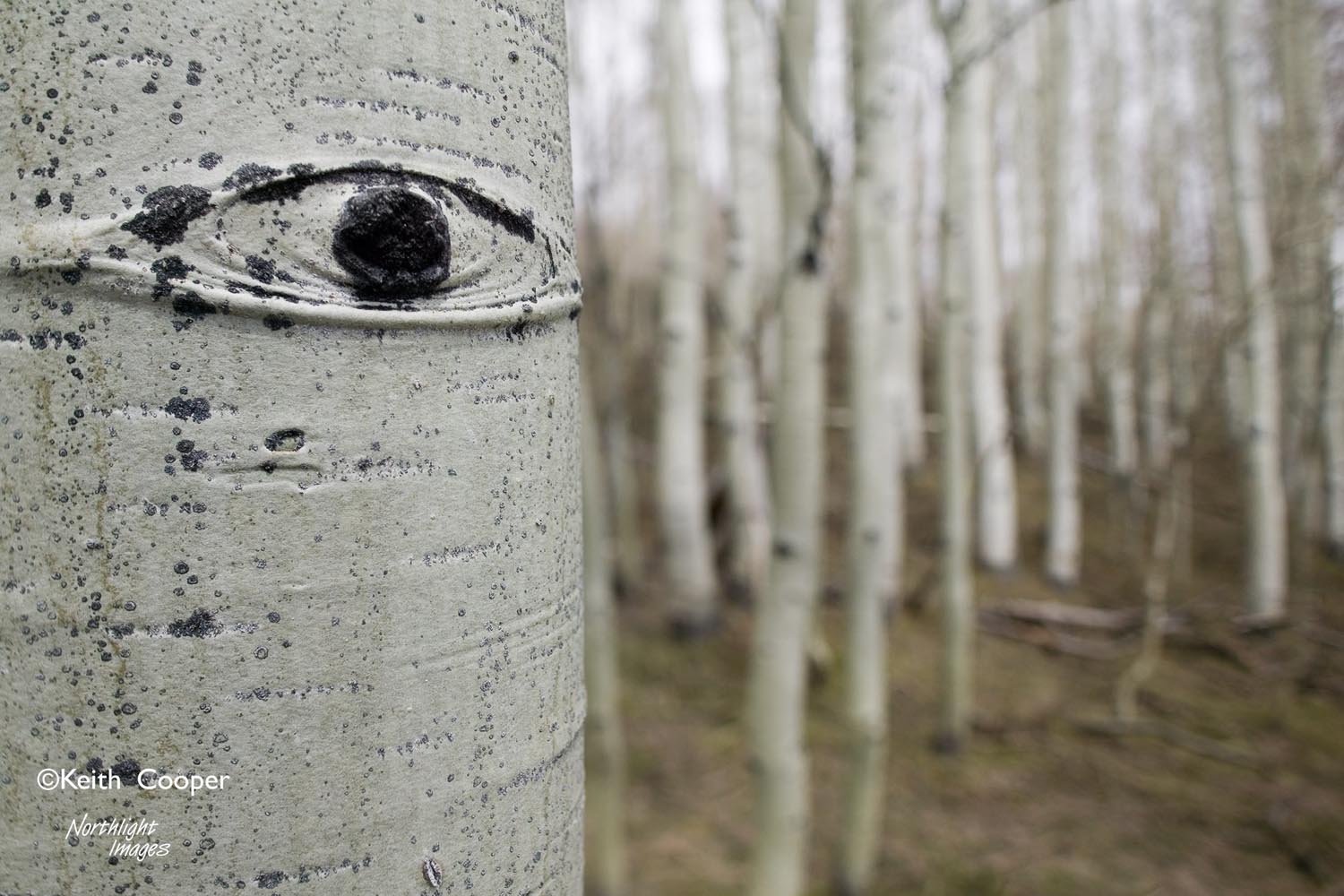
And lastly, remember to look upwards ever so often, whether it’s architecture or the natural world.
This from a forest in Oregon.

I hope that’s not too much to remember.
The take home message
If I was to pick just one thing for my ‘Elevator Pitch’ for better holiday photography, it would be to move the horizon and other features (such as people) away from the centre of the view.
Oh, and take more photos!
Some more Information
- Making a photograph – the Hood Canal print
- Photography tutorials and ‘How-to’ articles
- Black and white – page with links to all our B&W photography related articles/reviews
Never miss a new article or review - Sign up for our occasional (ad-free) Newsletter
and please do subscribe to Keith's YouTube Channel

Other areas of our site that may be of interest...
All the latest articles/reviews and photo news items appear on Keith's Photo blog

Keith explains tilt and shift lenses
Keith has written a book that looks at the many ways that tilt/shift lenses can benefit your photography from a technical and creative point of view. If not in the UK check for import issues and maybe try an on-line bookshop. Keith has no connection with sales of the book.
ISBN 9781785007712
There is also a specific index page on the site with links to all Keith's articles, reviews and videos about using tilt and shift.
We've a whole section of the site devoted to Digital Black and White photography and printing. It covers all of Keith's specialist articles and reviews. Other sections include Colour management and Keith's camera hacks - there are over 1200 articles/reviews here...
No more Google ads. Too many deceptive and irritating adverts.
Any ad links left are non tracking, to companies we know, trust and we've worked with for years [Park Cameras]
Ads helped pay for site running costs, so if you found something useful, please
...Make small KoFi donation?
...Subscribe to Keith's YouTube Channel
...Get Keith's book about how to use tilt/shift lenses
Our site contains affiliate links - these help support the site. See our Advertising policies for more