


Review: The unique Laowa 12-24 shift zoom lens f/5.6 APS-C
Review: Laowa 12-24 shift f/5.6 Zoom Shift lens
A zoom shift lens for APS-C cameras
Wide range of mounts Sony E / Nikon Z / Canon RF / L Mount / Fuji X / EF-M

No more Google ads. Too many deceptive and irritating adverts.
Any ad links left are non tracking, to companies we know, trust and we've worked with for years [Park Cameras]
Ads helped pay for site running costs, so if you found something useful, please
...Make small KoFi donation?
...Subscribe to Keith's YouTube Channel
...Get Keith's book about how to use tilt/shift lenses
Our site contains affiliate links - these help support the site. See our Advertising policies for more
Venus Lens have produced the first zoom shift lens, the Laowa 12-24mm f/5.6 Zoom Shift CF
Available [$699]: Laowa 12-24 shift lens
This is the first shift lens aimed at crop sensor cameras and represents a first in giving wide shift [~19mm FOV equivalent on Canon APS-C, ~18mm equivalent on other APS-C cameras].
An absolute boon to real estate photographers and people wanting a small shift lens for architectural studies.
It is shift only.

Venus Optics: Laowa 12-24mm f/5.6 Zoom Shift CF
Short overview [5mins]
See my initial video review and discussion about this lens. [Note: 28 minutes long]
The Laowa 12-24mm f/5.6 Zoom Shift CF lens is the first shift lens I’ve looked at for crop sensor cameras since my 15mm shift macro lens review some time ago [2016].
Laowa 12-24 shift: Zoom and APS-C
It’s also the first zoom shift lens I’ve looked at although I’ve seen examples of larger zoom lenses [medium format] being used with shift adapters.

Yes, you could do the corrections above [verticals] in software, but with difficulty in composition, loss of resolution and rather more effort than I’d ever want.
There is no tilt option here. As an architectural photographer, that doesn’t bother me much since it’s rarely something I ever need in my work with wider lenses. If you want to experiment with the so called ’tilt-shift’ effect look elsewhere…
The Laowa 12-24 shift lens has no electronics – it is entirely manual. So, no lens data in EXIF and no settings visible in the viewfinder.
That also means that if you want to use your camera’s sensor based Image Stabilisation [IS], you will need to set the focal length.
Note the lack of electrical contacts – this is the RF mount version.

The shift is limited to ±7mm. It is activated via the ring immediately below the shift indicator.
The lens rotates freely [press the tab near ‘315’] so that shift can be in any direction.

The movements are smooth, but take care with that locking knob, it could do with a ‘softer’ action I feel.
Note that I always refer to shift and its direction, rather than the more traditional rise/fall/shift terminology. In years of teaching people, mostly from a small camera background, the fundamentals of tilt and shift, the concept of shifting or tilting a lens in a particular direction seems to be more intuitive. Of course, if you come from a large format camera background, you should know all this stuff inside out anyway…
I mentioned the ring to activate shift.
Note that the lens has four control rings. All four have the same knurled finish and are distinctly easy to get mixed up.
This is a manual everything lens, so you will be using the aperture, focal length and focus rings a lot.
They are very easy to get mixed up, especially the aperture and zoom rings. I had to keep double checking that I’d not accidentally set the wrong one, or moved something.

Laowa 12-24 shift: 77mm filter thread
The Laowa 12-24 shift comes with a metal lens cap [bayonet fitting] and a lens hood, which is threaded to accept 77mm filters

The lens hood uses the same fitting as the cap, so you cannot have both on the lens at the same time.
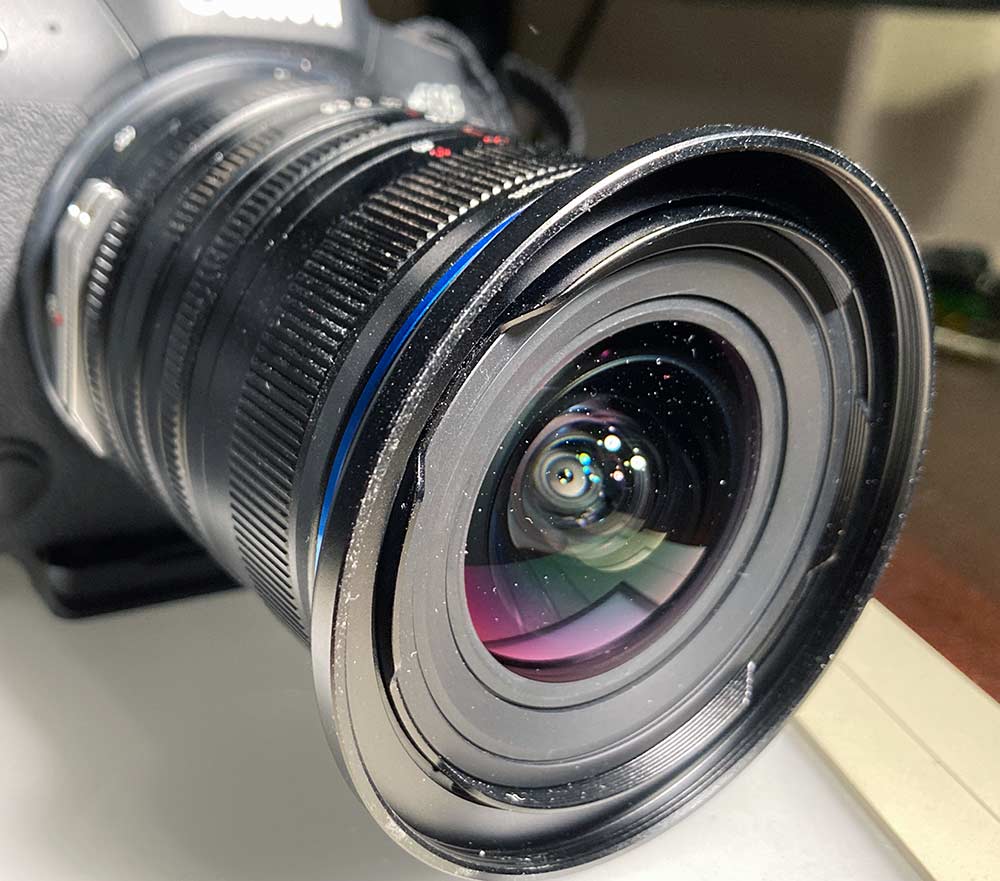
Some 77mm lens caps would work – but that depends on their design.
Shift and zoom? How it looks and what shift does
The shift function is the main reason you would get this lens…
Here’s a sequence of shots from 24mm to 18mm to 12mm. Very much as you’d expect from a nice wide zoom lens and level camera.


Now a set from almost the same spot, but using some vertical shift to better frame the building, and with a level camera, keeping vertical lines true.
Some shift? Remember, there is no EXIF data and even for lenses which do supply data, almost no tilt/shift lenses include movement info.


7mm of shift is a lot, on a crop sensor
Looking at the specs of other shift lenses, you might think 7mm is somewhat limited? However, remember that 7mm on a crop sensor is proportionally more than say 10mm on a full frame one.
Here are two more sets of images showing just how much movement 7mm on the Laowa 12-24 shift gives you.


And now with the full 7mm of vertical shift.


If you’re curious about how tilt and shift works on crop sensor cameras, see my video/article
Laowa 12-24 shift: Stitching images
Looking at the pairs of images above, it might occur that you can stick them for even more coverage?
You can actually get three shots unshifted and two others, up and down [or left/right]


Here’s the stitched result.

Of course, you could match this one [almost] with a single shorter focal length shot]

The stitched version gives more detail, but for interiors, you do run the risk of some parallax errors affecting the results.
In my work, I use up.down stitches quite a bit and parallax has never been the issue for me that some seem to think it is.
A simple example showing a single shot, vs expanding the composition with a shifted shot.


Left/right and panoramic stitching
Shifting left/right and stitching is a good way of shooting panoramic images.
There are a few issues you need to consider.
At full shift, the far edge of the frame is well into the zone where image quality falls off. Take extra care in focussing since it will show up asymmetrical softness and any field curvature of the plane of focus.
Aberrations increase towards the edge – geometric ones can differ in form from one side of the shifted frame to the other. Forget automatic geometry correction in your editing software – it will not work.
Expect to shoot at least f/8 and more likely f/11 to maintain quality.
Also – experiment with modern AI sharpening tools and masked adjustments. For example, I’ve found that edge distortions can sometimes be fixed more effectively by treating them as camera shake. [I cover this in some of my other Laowa shift lens reviews].
Laowa 12-24 shift specifications
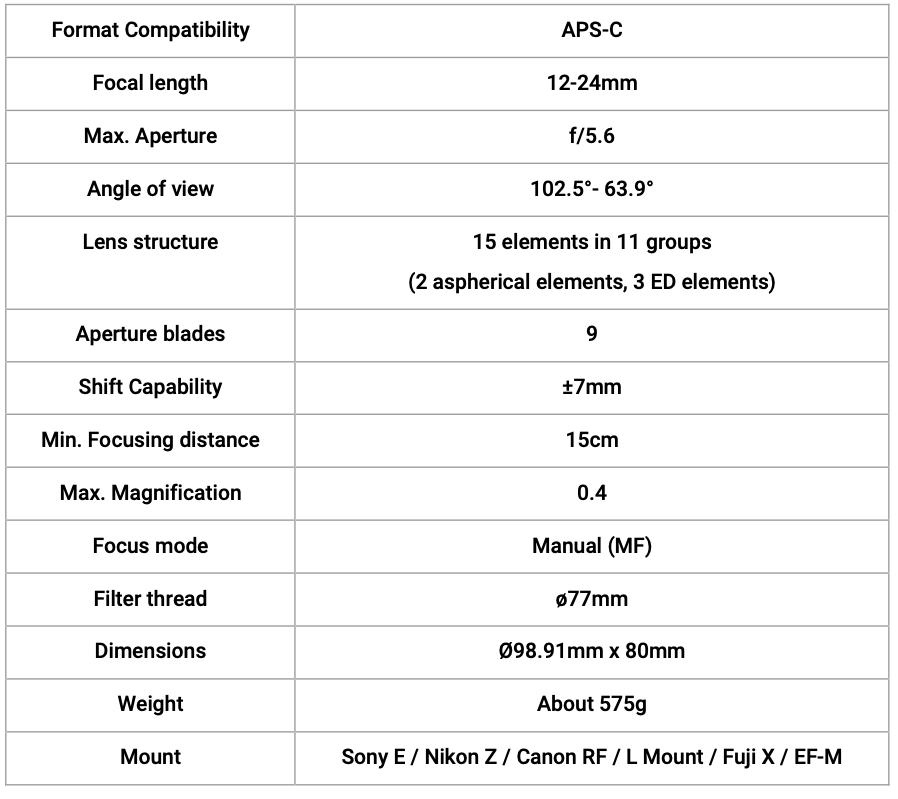
Lens construction

The front elements move forward as you go from 24mm to 12mmm whilst the rear elements move back, towards the sensor.

24mm

12mm
The 9 blade aperture gives some sunstars above f/5.6 but they are not overly prominent. See the close up examples below.
Laowa 12-24 shift: MTF charts
This lens, without shift makes for a lightweight full frame zoom. the image circle is large enough that even at 12mm, there is enough coverage of an APS-C sensor to get 7mm of shift. 7mm may not sound much, but as a proportion of the sensors size it is very noticeable, as you can see in some of the earlier examples.


The MTF charts suggest that with small amounts of shift, the distortions will be relatively well controlled, and softness only becoming more obvious when fully shifted, in the direction of the shift..
Bear in mind that this is an f/5.6 lens to start with. I found that f/8 definitely improved edges, and if using at full shift, f/11 was a better option. Not too dissimilar to many other shift lenses.
I’ve only the one lens to test here, so I’m not doing detailed tests of performance [I’m sure others will produce tables of data…]
My key criteria for this lens are geometric distortion and general sharpness. I should note too that I’m testing the lens on a 45MP full frame EOS R5 in crop mode, which for the Canon, gives me ~18MP images. Exactly the same as Karen’s old 100D, but that is EF-S mount and won’t take an RF mount lens. Of course, the 18MP from the R5 is from a much better sensor, and one with image stabilisation. If you are relying on IS, then the need to set the focal length in use is a bit of a limitation given the zoom – setting 18mm seemed to work OK, but you may want to experiment with any other cameras.
I’d note that as a ‘full frame lens’ the 12-24 works very well without shift, and at 575g is distinctly lighter than my ‘big’ tilt/shift lenses.
Laowa 12-24 shift: Vignetting
I test vignetting qualitatively with a light box – this test is included in almost every tilt/shift lens review I’ve done.

Even here, I had to keep double checking that I’d not moved the wrong control ring…

A series of shots gives a good feel for vignetting at different settings and with shift. [click to enlarge]

Remember that I have edited these screen shots to show the vignetting – it is not nearly so obvious in real use indoors or out.

As you can see, strong shift and short focal lengths show the most obvious effects.
‘Full Frame’ coverage
It’s important to note that this lens is sold as being for APS-C cameras…
Whilst I was out testing the lens on the Canon R5 I switched back to the full 36x24mm sensor
Here’s a shot at 12mm with 7mm vertical shift.
Note the hard vignetting in the top corners.

Switching to a 1:1 or square crop [24x24mm ~30MP]
There is a falloff in brightness, but perfectly usable at f/11

Repeating my vignetting test on the light box, lets me see the hard cutoff of the lenses image circle at different focal lengths.

A full set of images shows how shift is usable on full frame at longer focal lengths.

Laowa 12-24 shift – lens aberrations
Chromatic aberration is well controlled, but is there if you zoom in a lot [200% below]
It’s easily fixable with the automatic corrections of Adobe Camera Raw for example, where the asymmetry in a shifted shot causes no issues

When zooming in to explore this image [and I’m just really checking CA in this one], I noticed the slight moire fringing on one of the vents. That’s always a good sign for lens sharpness – despite the seeming overall softness of this frame edge at 12mm.

Laowa 12-24 shift: Geometric distortion
Once again one I’ll leave to other to provide you with charts and graphs.
I expect some variability in geometry with a zoom lens design – the question is how much have the lens designers opted to control this rather than other aberrations, since lens design is always about compromises.
Some shots [12/16/20/24mm] face on to this building. I used full vertical shift to give a feel for how visible such distortions will be. I’m shifting upwards to capture more of the lens image circle.

The camera is level and pointing square on to the building. This is one time where a magnified view showing my own reflection is really helpful in lining up the camera before adding shift.


I’m seeing a bit of pincushion distortion at longer focal lengths moving to a bit of a mix at 16mm and barrel distortion at 12mm.
This is at a level I’d expect for a well corrected zoom. Remember that with no EXIF data there isn’t the auto correction options available as you find with many modern zooms. Other than the two Fujifilm medium format tilt/shift lenses I’ve reviewed, no T/S lenses provide data about movements, for correction.
Laowa 12-24 shift – Close focus :15cm
At its closest you can position subjects just a few inches in front of the lens [click to enlarge].
This set of images shows the DOF [and out of focus sunstars] stepping from f/5.6 to f/22


A second set, focussing on the clock. Once again f/5.6/8/11/16/22

Note the flare of the lights in the f/5.6 example above. In general I shot most of my test examples at f/8 or a bit more if using much shift].


Laowa12-24 shift conclusions
So how useful is the 12-24 for architectural work? I’d say very, if you are looking for a light transportable ‘walk round’ lens.
I suspect, from looking at some of the interior examples, that this lens is ideal for real estate photography, where the ability to add shift to very wide shots, or stitch if need be, could easily result in a noticeable step-up in the quality of work.
Yes, there is some vignetting and distortion, but in many images I have difficulty in seeing it, and I’m looking for it.

As a travel lens on a small camera, it would get me out of lugging around some of my normal kit…

In terms of image quality, there was a noticeable benefit to be gained in shooting at f/8, or even nearer f/11 if I was using much shift.
Shift or not?
I’ve concentrated on the shift abilities of this lens – whether you use that is at heart a creative choice.


That said, if you just want a wide zoom, other faster lenses are available.
But if you want shift – there is nothing else…
Physical handling
Yes, at 575g it’s a lovely light lens, but my key gripe was with the physical ergonomics of the four control rings. The aperture and focal length rings don’t stand out enough from a tactile point of view, and they are too similar. I kept having to double check settings – even more important, since with no electronics, there is no info in the viewfinder.

Full frame on the Laowa 12-24 shift?
As I discovered, you can get full frame coverage and even a bit of shift above 18mm. Set the camera to a square crop and the lens is none too bad. I tested this partly because I could, but also because it extends the usefulness of the lens.
Laowa 12-24 shift lens: Summary
- A unique lens that at just under $700 will appeal to many wanting something different to go on their crop sensor camera.
- Wide range of APS-C mount options
- 7mm of shift is more than enough on a crop sensor.
- Shift only – no big loss for most people at this focal length
- Can take 77mm filters
- ~575g weight – much less the most shift lenses
- Relatively low distortion
- Fully manual operation – works best for those willing to put in the effort to learning what it can do.
Laowa 12-24 shift: Pricing & Availability
The 12-24mm f/5.6 Zoom Shift is currently available to purchase via Venus Optics official website and authorised resellers. It is priced at USD699 for Sony E, L mount, Canon R, Fuji X, Nikon Z, Canon EF-M. Price varies in different countries.
Never miss a new article or review - Sign up for our occasional (ad-free) Newsletter
and please do subscribe to Keith's YouTube Channel

Other areas of our site that may be of interest...
All the latest articles/reviews and photo news items appear on Keith's Photo blog

Keith explains tilt and shift lenses
Keith has written a book that looks at the many ways that tilt/shift lenses can benefit your photography from a technical and creative point of view. If not in the UK check for import issues and maybe try an on-line bookshop. Keith has no connection with sales of the book.
ISBN 9781785007712
There is also a specific index page on the site with links to all Keith's articles, reviews and videos about using tilt and shift.
We've a whole section of the site devoted to Digital Black and White photography and printing. It covers all of Keith's specialist articles and reviews. Other sections include Colour management and Keith's camera hacks - there are over 1200 articles/reviews here...
Adverts removed